Stars

Artistic concept of the Kepler-1658 system (Image courtesy Gabriel Perez Diaz/Instituto de Astrofísica de Canarias)

An article to be published in “The Astronomical Journal” offers evidence that confirms the existence of the exoplanet Kepler-1658b almost ten years after the detection of its first traces by NASA’s Kepler space telescope, which made it the first candidate discovered in its mission. A team of researchers led by Ashley Chontos, a student at the University of Hawaii, reviewed the data collected after that first detection also using the technique of astroseismology to confirm that the planet actually exists. The results were also presented in recent days at the Kepler/K2 Science Conference held in Glendale, California.

MMS5/OMC-3 (Image ALMA (ESO/NAOJ/NRAO), Matsushita et al.)

An article published in the journal “The Astrophysical Journal” reports the analysis that led to unveil the origin of two gas flows from the newborn star MMS5/OMC-3. A team of researchers used the ALMA radio telescope to study this situation which was a mystery because there are two very different flows since one is a slow outflow while the other is a fast jet and they concluded that they were formed independently in different parts of the gas disk surrounding the star.

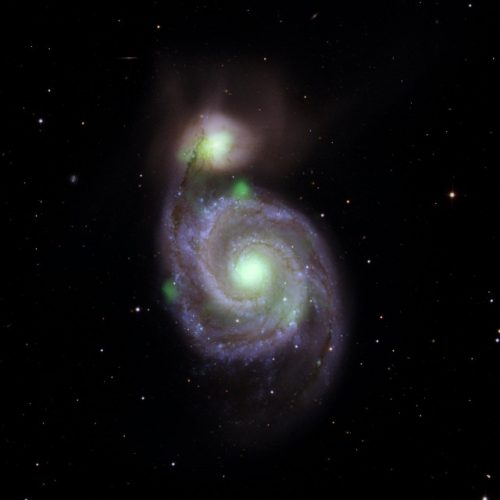
Surprising high-energy X-ray emissions from the Whirlpool Galaxy and its small companion

An article published in “The Astrophysical Journal” presents an in-depth spectral analysis of the two active galactic nuclei and other X-ray sources of the two galaxies that form M51. A team of researchers used NASA’s NuSTAR space telescope to detect high-energy X-ray emissions, which can pass through the layers of dust and gas that orbit the two supermassive black holes at the center of the two galaxies that are interacting in an initial phase of a galactic merger. A surprise came from the emissions of a neutron star in the Whirlpool Galaxy, the larger of the pair.

The starts that form the cosmic river in red with a Gaia map in the background (Image Meingast et al / Gaia DR2 skymap)

An article published in the journal “Astronomy & Astrophysics” reports the discovery of what was called a river of stars, a stream of stars a little over 300 light years away from us that occupies most of the southern sky. Astronomers of the University of Vienna used information collected by ESA’s Gaia space probe and published in the so-called Data Release 2 (DR2) to discover at least 4,000 stars that have been moving together in space since their formation, which was about a billion years ago.

Supernovae and water in rocky planets

An article published in the journal “Nature Astronomy” reports the results of a series of computer simulations conducted to better understand the mechanisms of rocky planets formation. A team of researchers concluded that there are probably two types of planetary systems: those similar to the solar system, with planets containing relatively little water, and those in which there are above all the so-called ocean planets or waterworlds. The difference may have been caused by the presence of a massive star nearby that ejected radioactive materials that have at least partially dried out the planets. This might have led to the emergence of a temperate climate on Earth.