Stars

An explanation to the mystery of the stars surrounded by iron dust

An article published in the journal “The Astophysical Journal Letters” reports the study of stars surrounded by iron dust in the Large Magellanic Cloud, one of the Milky Way’s satellite dwarf galaxies. A team of researchers led by Ester Marini, a doctoral student of the “Roma Tre” University, Rome, Italy, used data collected by NASA’s Spitzer Space Telescope to examine these stars that are in a phase of their life in which they lose their outer layers. Normally, that type of stars is surrounded by silicates and the anomaly is interesting because the dusts are important in the formation of new stars and planets as well.

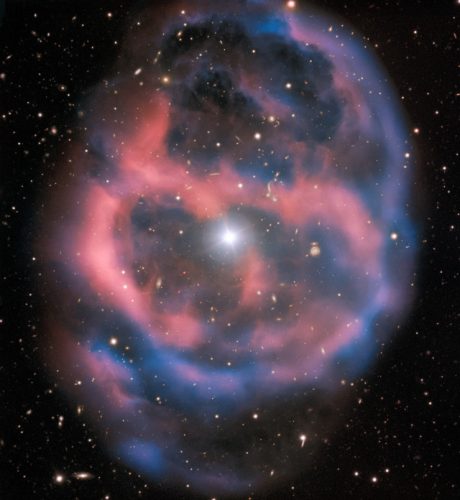
The planetary nebula ESO 577-24 seen in all its beauty by the Very Large Telescope

ESO has published a new image of the planetary nebula ESO 577-24 captured by its Very Large Telescope (VLT) in Chile thanks to its FORS2 instrument, which for almost twenty years has been capturing some of the best astronomical images obtained by the VLT. ESO 577-24 represents the final phase of the life of the star at its center, cataloged as Abell 36, in astronomical terms an instant of agony since its duration is estimated around 10,000 Earth years.

A rare hypernova shows the possible death of a very massive star

An article published in the journal “Nature” reports the observation of a gamma-ray burst (GRB) cataloged as GRB 171205A associated with a supernova cataloged as SN 2017iuk that was tens of times brighter than that type of event generally is, so as to fall into the category of hypernovae. A team of astronomers led by Luca Izzo of the Instituto de AstrofĂ­sica de AndalucĂ­a (IAA-CSIC) detected for the first time interaction between the jet that caused the GRB and the outer layers of the exploded star. This allowed to better understand the mechanisms that combine hypernovae and gamma-ray bursts, connected to a “hot cocoon”.

SN 2015 cp is a rare type Ia supernova

An article accepted for publication in “The Astrophysical Journal” reports the discovery of a type Ia supernova, cataloged as SN 2015 cp. A team of astronomers led by Melissa Graham of the University of Washington used observations made with the Hubble Space Telescope and others to study a binary system in which a star that could be a red giant ejected huge amounts of materials and a part reached its companion, a white dwarf, causing its explosion.

A cosmic explosion has different interpretations

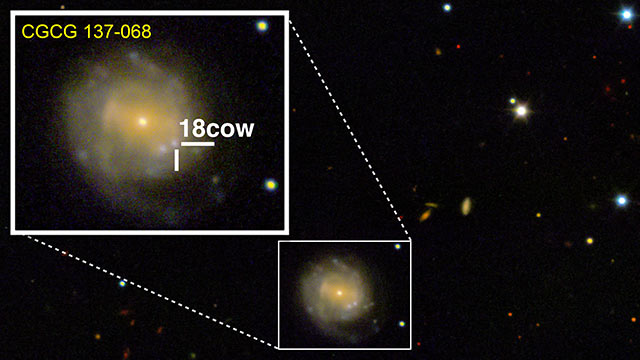
Two articles, one to be published in the journal “The Astrophysical Journal” and one in the journal “Monthly Notices of the Royal Astronomical Society”, describe studies of an anomalous event and an object cataloged as AT2018cow and therefore nicknamed “The Cow”. According to a team led by Raffaella Margutti of Northwestern University, who produced the article to be published in “The Astrophysical Journal”, it could be an anomalous supernova, tens of times brighter than normal that generated a black hole or a neutron star, while another team led by Paul Kuin of University College London (UCL), who produced the article to be published in “Monthly Notices of the Royal Astronomical Society”, it could be a black hole that destroyed a star.