Stars

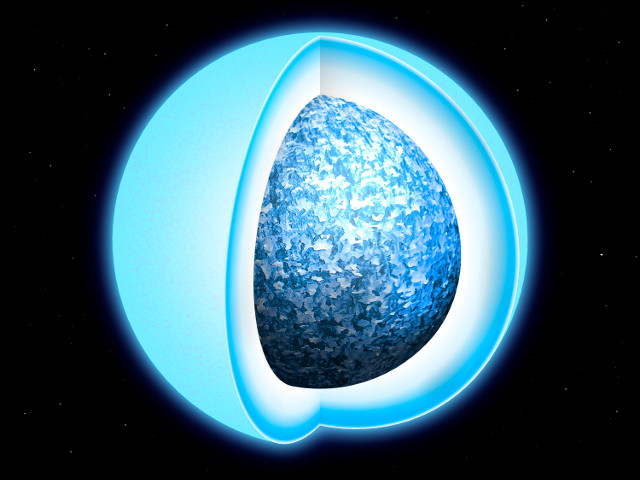
Artist’s impression of crystallisation in white dwarf (Image courtesy University of Warwick/Mark Garlick. All rights reserved)

An article published in “Nature” shows the evidence that in white dwarfs oxygen and carbon slowly crystallize from their cores. A team of researchers used data collected by ESA’s Gaia space probe that include distance, brightness and color of hundreds of thousands of white dwarfs analyzing over 15,000 candidates within 300 light years away from Earth to collect evidence of the crystallization process. This is the first verification of a prediction dating back to the beginning of the 1960s.

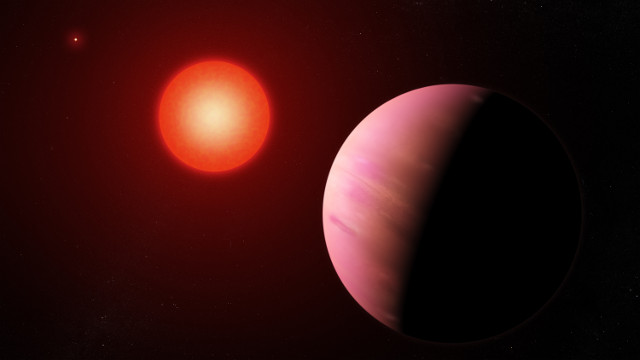
Artist's concept of the exoplanet K2-288Bb with its star and the other red dwarf far away (Image NASA's Goddard Space Flight Center/Francis Reddy)

An article published in the journal “The Astronomical Journal” describes the study of the exoplanet K2-288Bb, discovered among the observations made by NASA’s Kepler space telescope with the help of citizen scientists thanks to the Exoplanet Explorers project. Adina Feinstein, a University of Chicago graduate student and lead author of the paper, presented the results at the 233rd meeting of the American Astronomical Society in Seattle held in Seattle.

Artist's concept of a star with a violent flare (Image Casey Reed/NASA)

An article published in the journal “Monthly Notices of the Royal Astronomical Society” reports the detection of a powerful stellar flare generated by the young star cataloged as NGTS J121939.5-355557 or more simply as NGTS J1219-3555. A team of astronomers used the Next-Generation Transit Survey (NGTS) telescope array in Chile to observe a rare event that could be important for exoplanet formation in a system that is still in formation.

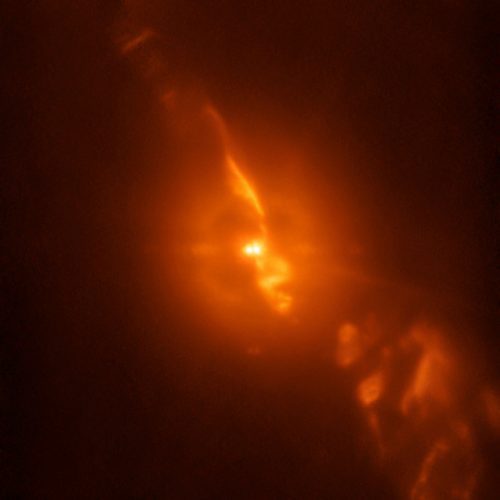
R Aquarii (Image ESO/Schmid et al.)

An article published in the journal “Astronomy & Astrophysics” describes a new observation of the R Aquarii binary system, consisting of a red giant of the type called Mira variable and a white dwarf. A team of researchers used that pair of stars as a target for a test of a new subsystem of the SPHERE instrument mounted on ESO’s VLT obtaining the clearest image captured so far of the turbulence existing in the system due to the fact that the white dwarf is stealing gas from its companion, worsening its agony.

Planetary formation discovered in the Taurus molecular cloud

An article published in the journal “The Astrophysical Journal” reports the observation of structures in protoplanetary disks that probably were left by newborn and perhaps still developing planets. A team of researchers led by Feng Long of the University of Beijing used the ALMA radio telescope to examine disks surrounding young stars in the Taurus star formation region discovering that of 32 protoplanetary disks 12 were divided into rings, a situation associated with planetary formation.