Stars

NGC 2467 seen by FORS2 (Image ESO)

ESO has published a photo of the nebula NGC 2467, also known as the Skull Nebula, taken using the FORS2 instrument mounted on the VLT in Chile. It’s a stellar nursery as it contains a lot of gas that’s still forming a number of new stars and consequently sees a predominance of young, often massive, stars. The photo was taken as part of ESO’s Cosmic Gems programme, which has also an educational purpose.

A new study of the youngest pulsar discovered in the Milky Way

An article published in the journal “The Astrophysical Journal” describes the study of a pulsar cataloged as PSR J1846-0258 found among the remnants of a supernova called Kes 75. A team of researchers used information collected with NASA’s Chandra X-ray observatory between 2000 and 2016 to study the pulsar’s characteristics. They confirmed that it’s the youngest discovered in the Milky Way and could help to better understand that kind of objects, also because they discovered a pulsar wind nebula, a cloud of gas around it created thanks to a very elevated rotation and magnetic field.

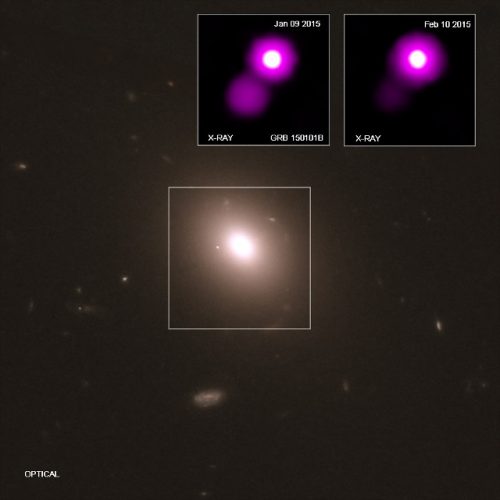
A gamma-ray burst from 2015 shows many similarities with a neutron star merger

An article published in the journal “Nature Communications” describes an analysis of the gamma-ray burst cataloged as GRB150101B. A team of researchers led by Eleonora Troja of NASA pointed out the similarity between this gamma-ray burst and the electromagnetic signals emitted by the event cataloged as GW170817, the neutron star merger detected at both electromagnetic waves and gravitational waves. A year after the sensational announcement of that event, the authors of this new research believe they have discovered another one of that type.

Artist's concept of the CI Tauri system with its planets (Image courtesy Amanda Smith, Institute of Astronomy)

An article published in the journal “The Astrophysical Journal” describes the discovery of four gas giant planets orbiting the young star CI Tauri. A team of researchers coordinated by the British University of Cambridge used the ALMA radio telescope to study that star system in which one of the four planets had already been discovered, a hot Jupiter that was the first in its class to be discovered in a very young system. There’s still a protoplanetary disc that revealed gaps where the other planets formed, much farther than the one already known.

A strange dim and fast supernova

An article published in the journal “Science” describes the study of a supernova cataloged as iPTF 14gqr which had a very short duration emitting a relatively dim light and ejecting a limited amount of materials. A team of researchers studied this out-of-the-ordinary supernova using observations from the Palomar Observatory and other telescopes concluding that probably the fault is of a companion, a neutron star that attracted many layers of the dying star, limiting its explosion. The supernova probably produced another neutron star forming a binary system of which in the distant future we might see the merger.