Stars

CK Vulpeculae seen by ALMA (Image ALMA (ESO/NAOJ/NRAO)/S. P. S. Eyres)

An article published in the journal “Monthly Notices of the Royal Astronomical Society” describes a research on CK Vulpeculae (CK Vul), a nova that was well documented between 1670 and 1672 that left a bipolar nebula. A team of researchers led by Stewart Eyres of the University of South Wales used the ALMA radio telescope to analyze that explosion’s remnants, concluding that it was caused by the collision between a white dwarf and a brown dwarf, the first anomalous nova of this type identified.

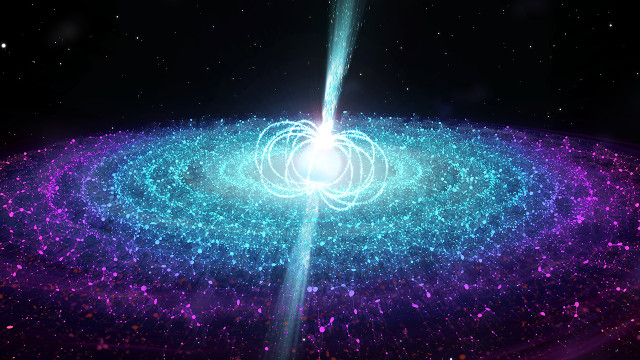
Artist's concept of neutron star with jets of material, magnetic field and accretion disk (Image courtesy ICRAR/Universiteit van Amsterdam)

An article published in the journal “Nature” describes the discovery of a pulsar-type neutron star with a very strong magnetic field that emits a jet of materials. A team of researchers used the Very Large Array (VLA) radio telescope to study the neutron star cataloged as Swift J0243.6+6124 and simply called Sw J0243 discovering an anomaly because according to the formation models for jets of material a pulsar with such a strong magnetic field shouldn’t be able to emit them.

Two objects in the Epsilon Indi system at the limit between star and brown dwarf

An article published in the journal “The Astrophysical Journal” describes a research on the brown dwarfs in the Epsilon Indi system in connection with the mass limits for this type of objects. A team of researchers combined the data obtained from various observations to re-estimate the two brown dwarfs masses, which were found to be 75.0 ± 0.82 and 70.1 ± 0.68 times the mass of the planet Jupiter. These are much higher masses than previous estimates and at least the largest one has a mass that according to the theoretical models is that of a star offering new information to understand where are the limits between these objects.

The images captured by TESS (NASA/MIT/TESS)

NASA has published a series of images captured by its TESS space telescope’s cameras. These are the first scientific images, that in jargon are called the first light, obtained on August 7, 2018 after the instrument testing period and show the southern sky. The images portray an amount of stars and other objects among which systems where exoplanets were already found. However, the main goal is to discover new exoplanets.

A possible pulsar formed after a long-duration supernova

An article published in the “Astrophysical Journal Letters” describes a study on the supernova Sn 2012au. Sometimes supernovae remain bright for a long time if the remnants of the explosion collide with hydrogen layers, but Dan Milisavljevic of Purdue University wondered if this could happen without any interaction of that kind. His team studied Sn 2012au concluding that after the supernova a neutron star of the pulsar type was formed with a rotation and a magnetic field sufficient to create a cloud of gas around it, called in jargon a pulsar wind nebula.