Stars

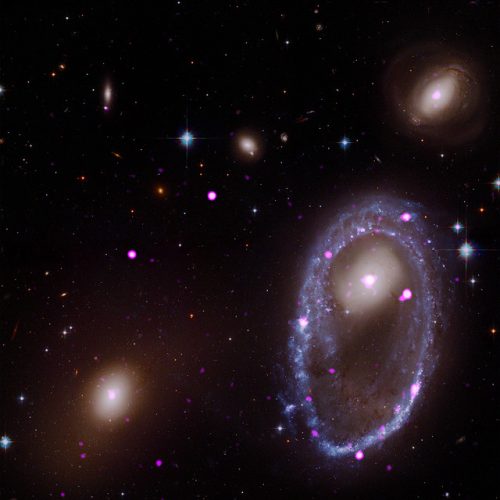
A ring galaxy with a lot of ultraluminous X-ray sources

An article published in the “Astrophysical Journal” describes the detection of a series of X-ray sources in the ring of the galaxy AM 0644-741. A team of researchers led by Anna Wolter from INAF-Osservatorio Astronomico di Brera, Italy, used observations from NASA’s Chandra X-ray Observatory to discover those ultraluminous sources concluding that the ring containing them consists of binary systems that include black holes or neutron stars and that the ring formed following a collision between galaxies.

A relativistic jet after the kilonova

An article published in the journal “Nature” describes the observations of a relativistic jet that followed the merger between two neutron stars discovered in August 2017, the first case of an event detected and studied in both electromagnetic and gravitational waves. A team of researchers used the precise measurements made with some radio telescopes to establish that a narrow jet of particles was emitted at a speed close to that of light after the event.

A false-color submillimeter-wavelength image of the IRAS 15398-3359 system (Image courtesy Yuki Okoda, Graduate School of Science, The University of Tokyo. All rights reserved)

An article published in the “Astrophysical Journal Letters” describes a study on the co-evolution of stars and protoplanetary disks based on the class 0 protostar cataloged as IRAS 15398-3359. A team of astronomers from the Department of Physics at the University of Tokyo led by Professor Yoko Oya used the ALMA radio telescope for this research, discovering a dense disk of materials around the protostar that could be a precursor to a planetary system. This discovery could improve our knowledge of the formation of solar systems.

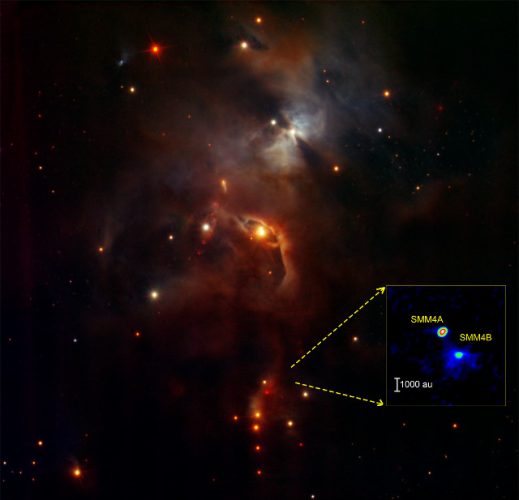
The Serpens Main star-forming cluster with SMM4A and SMM4B in the inset (Image ESO/ALMA(ESO/NAOJ/NRAO)/Aso et al.)

An article published in the “Astrophysical Journal” describes the observation of the growth of two class 0 protostars. A team led by Dr. Yusuke Aso of the Academy Sinica Institute of Astronomy and Astrophysics (ASIAA, Taiwan) used the ALMA radio telescope to study their different evolutionary states obtaining a series of details on the protostars cataloged as SMM4A and SMM4B. Class 0 protostats have their peak emissions at submillimetric wavelengths making ALMA ideal to get to know star gestation better.

An ancient galaxy with a frantic star formation

An article published in the journal “Nature” describes the mapping of a galaxy known as COSMOS-AzTEC-1 that showed peculiar characteristics. A team of astronomers used the ALMA radio telescope to study this starburst galaxy, a class in which there’s considerable star formation. COSMOS-AzTEC-1 is very far away so we see it as it was 12.4 million years ago and very massive and could be the progenitor of today’s large elliptical galaxies so this type of research could provide new information on their evolution.