Stars

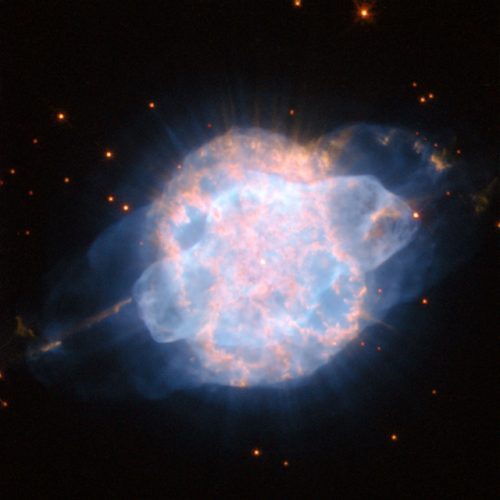
NGC 3918 (Image ESA/Hubble and NASA)

A new image captured by the Hubble Space Telescope shows the planetary nebula NGC 3918, nicknamed the “Blue Planetary” or “The Southerner”. Its shape in some ways reminds of an eye with special colors and seeing it is a lucky event because it will not last long in astronomical terms since this phase will end within a few tenth of millennia.

Milky Way panorama (Image ESO/S. Brunier)

An article published in the journal “Nature” describes a research on star formation in the Milky Way. According to Masafumi Noguchi of Tohoku University there were two star formation periods separated by 2 billion years. In essence, our galaxy had a first period in which it was vital then it died and after about 2 billion years star formation restarted in a sort of second life. According to this theory, during that period of death the gas present in the Milky Way got enriched with iron, the reason why stars like the Sun have a greater amount of it than others.

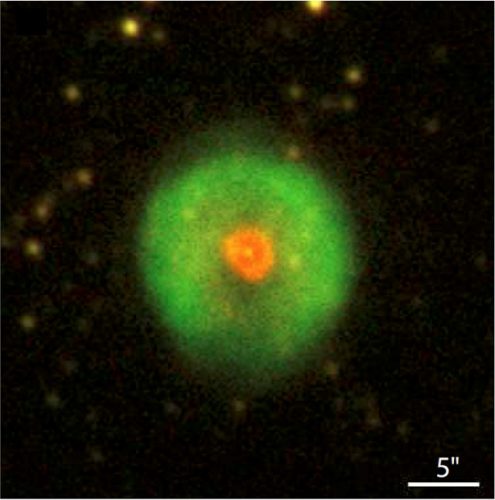
HuBi 1 (Image courtesy Guerrero, Fang, Miller Bertolami, et al., 2018, Nature Astronomy, tmp, 112. All rights reserved)

An article published in the journal “Nature Astronomy” describes a research on the planetary nebula HuBi 1. Normally that kind of structure marks a phase of a star’s agony but in this case a team of researchers discovered an nebula that’s inside-out. Their conclusion is that the star at its center is going through a sort of rebirth process so we see it while it’s ejecting materials from its surface and creating a shock wave that excites the nebula’s materials.

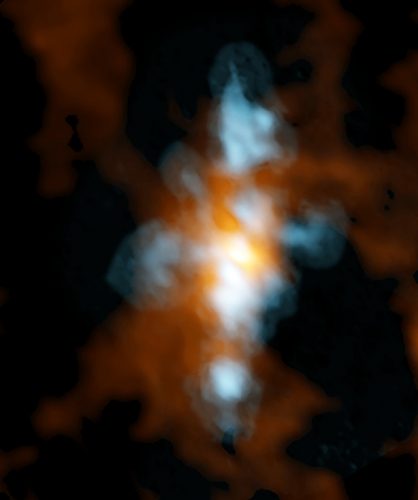
The NGC 6334I star formation region studied at the highest possible frequencies for the ALMA radio telescope

An article published in the journal “Astrophysical Journal Letters” presents the first results of a pilot program to investigate at the highest possible frequencies for the ALMA radio telescope. A team of researchers used the NGC 6334I star formation region within the Cat’s Paw Nebula as a target for observations in what is called band 10 detecting glycolaldehyde and a compact bipolar outflow containing heavy water and carbon monosulfide from the protostar MM1B.

HDUV GOODS-North Field Compass (Image NASA, ESA, P. Oesch (University of Geneva), and M. Montes (University of New South Wales))

An article published in the journal “Astrophysical Journal Supplement Series” presents the Hubble Deep UV (HDUV) Legacy Survey program, a great panorama of the universe’s evolutionary history based on observations carried out with the Hubble Space Telescope. A team of researchers exploited Hubble’s ultraviolet detection capabilities, combining it with infrared and visible light observations, also from other telescopes, to extend previous surveys with a field of view that includes about 15,000 galaxies, including 12,000 in which there’s star formation.