Stars

The PDS 70 system (Image ESO/A. Müller et al.)

Two articles to be published in the journal “Astronomy & Astrophysics” describe the discovery and characterization of a planet still in its formation phase orbiting the young star PDS 70. Two teams of astronomers used the SPHERE instrument installed on ESO’s VLT to obtain for the first time images of a planet while it’s forming in what is still more or less a disk of gas and dust around the star. Called PDS 70b, the planet is a gas giant that could be larger than expected for its age.

The TMC1A system

An article published in the journal “Nature Astronomy” describes the discovery that dust particles in a disk surrounding a protostar start coagulating even before the star has completed its formation. A team of researchers used the ALMA radio telescope to study the system in formation TMC1A noting the lack of radiation from carbon monoxide near the protostar. Their conclusion is that large dust particles are blocking those radiations, an important discovery because it means that in the disk of gas and dust the processes that will lead to the formation of planets have already begun.

MRK 1216

An article to be published in the journal “Monthly Notices of the Royal Astronomical Society” describes a research on isolated galaxies with a mass similar to the first elliptical galaxies but much smaller in which the central supermassive black hole inhibited stellar formation and grew more than normal. A team of researchers used data collected by NASA’s Chandra X-ray Observatory to examine the galaxies MRK 1216 and PGC 032873, nicknamed red nuggets, relics of the first massive galaxies that formed in the first billion years after the Big Bang.

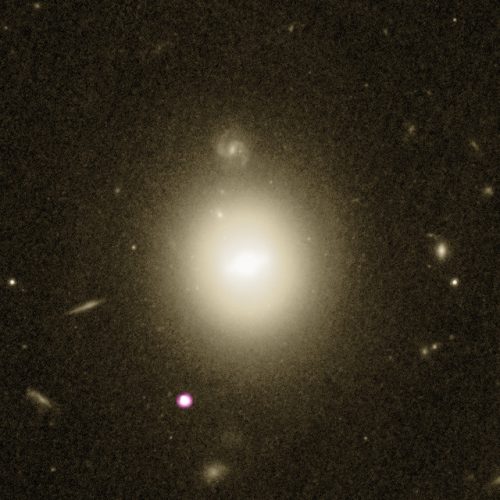
The galaxy galaxy 6dFGS gJ215022.2-055059 and the intermediate-mass black hole candidate

An article published in the journal “Nature Astronomy” describes the discovery of the best candidate found so far for a type of black hole that’s been elusive for a long time. A team led by Dacheng Lin of the University of New Hampshire’s Space Science Center used observations from a number of telescopes to detect flares at various wavelengths emitted in the area near an intermediate-mass black hole while destroying a nearby star in what is called the tidal disruption event.

The galaxies Arp 299A and Arp 299B and the tidal disruption event

An article published in the journal “Science” describes the discovery of a star destroyed by a supermassive black hole in what in jargon is called a tidal disruption event. A team of astronomers used various telescopes searching for supernovae in Arp 299, an object generated by two merging galaxies, but in one case they came to realize that the phenomenon in progress was not an explosion but the destruction of the star under observation.