Stars

A representation of the data collected with OSIRIS

During the 232nd American Astronomical Society Meeting, a team of researchers led by Anna Ciurlo of UCLA presented the results of a research on what were called G-objects. They look like dust clouds but act like stars and move very fast in the area around the supermassive black hole at the center of the Milky Way. Using data collected over the past 12 years by the Keck Observatory in Hawaii, the researchers concluded that these are bloated stars, so large that the black hole steal their materials from them.

Artist's concept of nanodiamonds in a protoplanetary disk (Image courtesy S. Dagnello, NRAO/AUI/NSF)

An article published in the journal “Nature Astronomy” describes the detection of nanodiamonds around three newborn star systems in the Milky Way. A team of researchers led by astronomer Jane Greaves of the Welsh University of Cardiff used the Green Bank Telescope (GBT) to observe the V892 Tau system and the Australia Telescope Compact Array (ATCA) to observe the HD 97048 and MWC 297 systems obtaining the first clear detections of anomalous microwave emissions (AMEs) concluding that the nanodiamonds are their source.

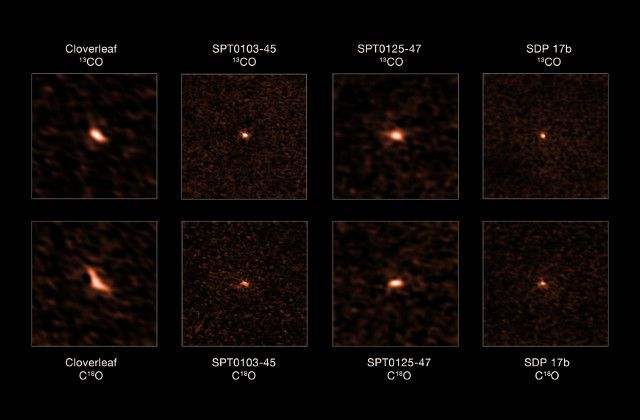
Carbon monoxide in starburst galaxies

An article published in the journal “Nature” describes the discovery of star formation regions where the percentage of massive stars is much higher compared to others. A team of astronomers led by Zhi-Yu Zhang of the University of Edinburgh used the ALMA radio telescope to study four very old dusty galaxies of the starburst type, meaning where there’s a high star formation rate.

GW170817 seen by XMM-Newton (Image ESA/XMM-Newton; P. D'Avanzo (INAF–Osservatorio Astronomico di Brera))

Two articles, one published in the journal “Astronomy and Astrophysics” and one in “The Astrophysical Journal Letter”, describe two researches on the consequences of the merger of two neutron stars detected last year at electromagnetic and gravitational waves. ESA’s XMM-Newton space telescope was used to monitor the evolution of its X-ray emissions. NASA’s Chandra X-ray observatory was similarly used and a team of researchers concluded that the merger generated a black hole.

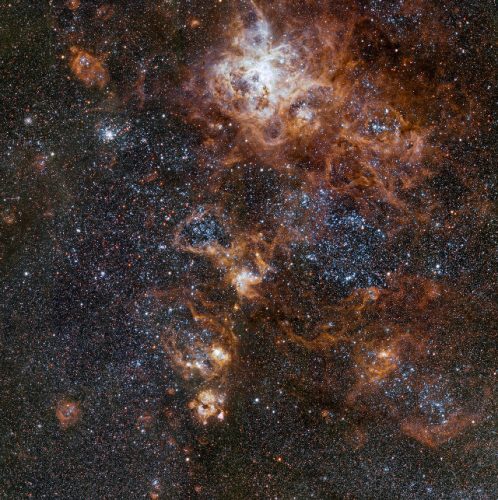
The Tarantula Nebula and its A crowded neighborhood for the Tarantula Nebula (Image ESO)

An image published by ESO shows the Tarantula Nebula along with the neighboring areas in their details. A team of astronomers used the VLT Survey Telescope (VST) at ESO’s Paranal Observatory, in Chile, to capture unseen details of star clusters, bright gas clouds and supernova remnants scattered around. It’s the sharpest image ever obtained of that region of the Large Magellanic Cloud, one of the Milky Way’s satellite dwarf galaxies.