
Stars

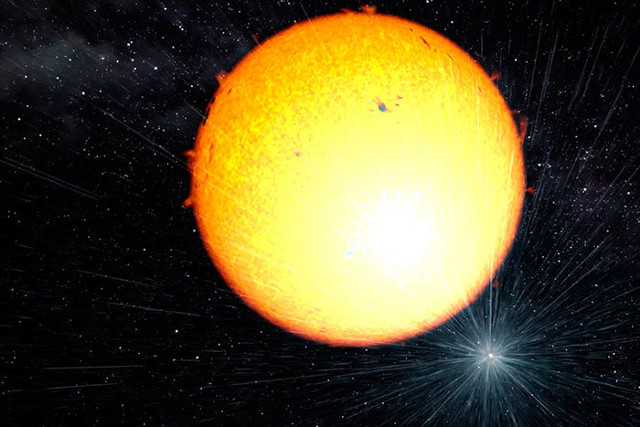
Artist's concept of PSR J2215+5135 irradiating its companion (Image courtesy G. Pérez-Díaz/IAC)

An article published in “The Astrophysical Journal” describes the study of a pulsar cataloged as PSR J2215+5135 which is extreme even for this category of objects. A team of researchers from the Universitat Politècnica de Catalunya (UPC) and the Canary Islands Institute of Astrophysics (IAC) used an innovative method to measure the mass of one of the most massive neutron stars discovered, estimated in 2.3 times the Sun’s. This is a method that can also be used with other objects.

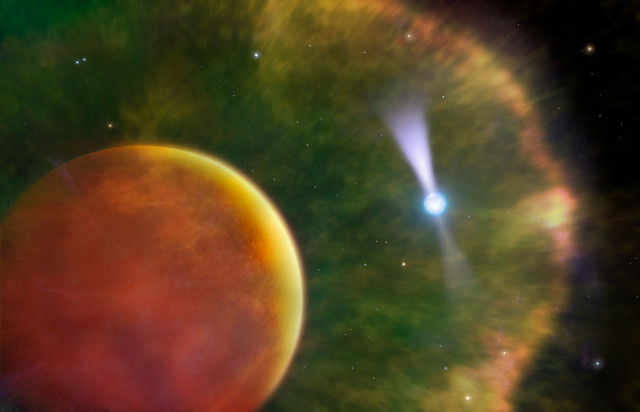
Illustration of PSR B1957+20 and its companion

An article published in the journal “Nature” describes a high resolution observation of a pulsar cataloged as PSR B1957+20. A team of astronomers used data collected using the Arecibo radio telescope, obtaining one of the best results in the history of astronomy thanks to the presence of a trail of plasma left by a brown dwarf, a companion of the pulsar in a binary system. According to the astronomers, the lens effect generated suggests that it’s also the cause of fast radio bursts.

Orion A (Image courtesy NSF/S. Kong, J. Feddersen, H. Arce & CARMA-NRO Orion Survey team)

An article published in the journal “The Astrophysical Journal Supplement Series” describes the results of the CARMA-NRO Orion Survey, a high-resolution mapping of the molecular cloud called Orion A, one of the two giant molecular clouds in the Orion molecular cloud complex. A team of astronomers combined the observations of the CARMA and NRO radio telescopes to map the stars but also the gas movements inside the cloud.

The Ant Nebula (Image NASA, ESA and the Hubble Heritage Team (STScI/AURA))

An article published in the journal “Monthly Notices of the Royal Astronomical Society” describes the discovery of laser emissions in the Ant Nebula. A team of astronomers used observations conducted with ESA’s Herschel space observatory to detect a very rare phenomenon connected to a star’s death. It suggests the presence of a binary star system in the heart of the nebula.

The galaxy cluster MACS J1149.5+2223 and in the inset the galaxy MACS1149-JD1

An article published in the journal “Nature” describes the discovery of the most distant traces of oxygen ever detected. A team of astronomers used the ALMA radio telescope and ESO’s VLT telescope to observe the galaxy MACS1149-JD1, where there are traces of star formation about 250 million years after the Big Bang, a very remote era in which so far there were just some clues of possible star formation.