Stars

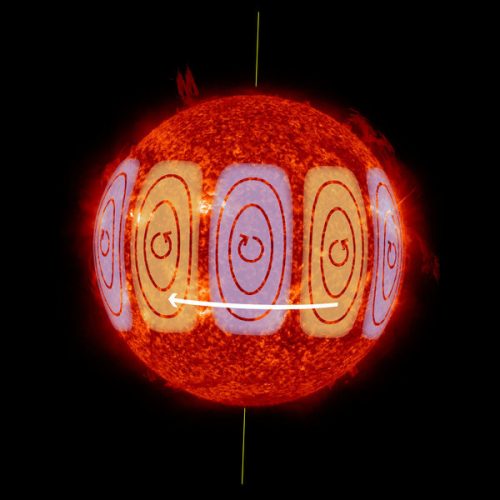
Diagram of solar Rossby waves (Image courtesy MPS/NASA/HormesDesign)

An article published in the journal “Nature Astronomy” describes the evidence of the presence of gigantic waves called Rossby waves on the Sun’s surface. A team of scientists led by the Max Planck Institute for Solar System Research (MPS) and the University of Göttingen discovered these vortices that have sizes comparable to those of the Sun itself, confirming a hypothesis that was proposed decades ago because they exist naturally in rotating fluids.

the W43-MM1 area (Image courtesy ESO/ALMA/F. Motte/T. Nony/F. Louvet/Nature Astronomy. All rights reserved)

An article published in the journal “Nature Astronomy” describes a research on a region of space about 18,000 light years from the Earth in which a remarkable star formation is being observed, cataloged as W43-MM1. A team of researchers used the ALMA radio telescope to study it and found that more massive stars are forming than predicted by current models.

The supernova SN 2001ig

An article published in “The Astrophysical Journal” describes the detection of a companion of the type IIb supernova known as SN 2001ig. A team of astronomers used the Hubble Space Telescope to discover the first case of a binary system in which one of the stars survived when its partner exploded into a supernova. The two stars were not just close but there was an interaction that had an influence on the supernova.

The SPT2349-56 proto-cluster (Image ESO/ALMA (ESO/NAOJ/NRAO)/Miller et al.)

Two articles, one published in the journal “Nature” and one in the journal “Astrophysical Journal”, describe the observations of the merger among various starburst galaxies, characterized by a remarkable production of stars. Two teams, led by Tim Miller of Dalhousie University in Canada and Yale University in the USA, and Iván Oteo of the Scottish University of Edinburgh used the ALMA and APEX radio telescopes to study these events which are very ancient as they happened about 1.5 billion years after the Big Bang.

Gaia's sky DR2 map (Image ESA/Gaia/DPAC)

ESA has published the second 3D map of the Milky Way and neighbouring galaxies obtained from the Gaia space probe, the most detailed of this type ever produced. This catalog, built thanks to what was called Data Release 2 (DR2), greatly expands the first map released by ESA in September 2016.

The Gaia space probe was launched on December 19, 2013 with the aim of creating a highly accurate 3D map of the Milky Way’s stars but also to catalog billions of other celestial objects, not only stars but also galaxies. Gaia began its scientific activity in July 2014, the first map included data collected until September 2015, the DR2 includes the following 8 months of observations.