
Stars

The Lagoon Nebula at visible light (Image NASA, ESA, and STScI)

On April 24, 1990, the Hubble Space Telescope was launched on the Space Shuttle Discovery and put into orbit the next day. To celebrate the 28th anniversary of that event, which represents a milestone in the history of astronomy, new breathtaking photos of the Lagoon Nebula have been published.

About 4,000 light years away from the Earth, the Lagoon Nebula was first cataloged by the astronomer Giovanni Battista Hodierna and later included in other catalogs, so much so that it’s known by various designations including Messier 8 or M8, NGC 6523, Sharpless 25, RCW 146, and Gum 72. In optimal conditions it’s visible even to the naked eye, so it’s the object of observations by amateur astronomers as well.

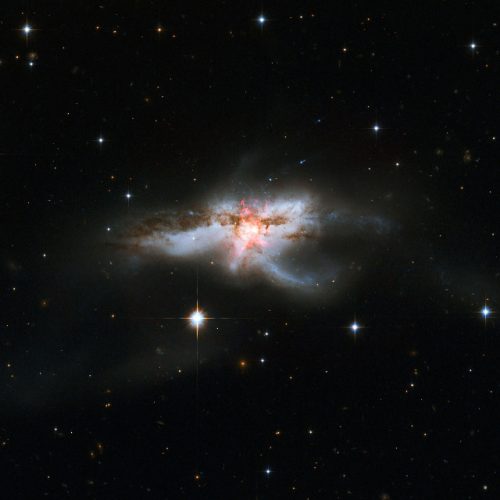
The galaxy NGC 6240 (Image NASA, ESA, the Hubble Heritage (STScI/AURA)-ESA/Hubble Collaboration, and A. Evans (University of Virginia, Charlottesville/NRAO/Stony Brook University))

An article published in the journal “Nature” describes a research on the formations similar to the wings of a butterfly in the galaxy NGC 6240. A team of researchers at the University of Colorado Boulder combined observations made with the Hubble Space Telescope, the VLT in Chile and the Apache Point Observatory in New Mexico to study that galaxy by concluding that those particular formations are generated by different forces, in one case by a pair of supermassive black holes.

Star systems observed by the SPHERE instrument (Image ESO/H. Avenhaus et al./E. Sissa et al./DARTT-S and SHINE collaborations)

Two articles, one published in the “Astrophysical Journal” and one in “Astronomy & Astrophysics”, describe two researches on a number of star systems. Two teams used the SPHERE instrument mounted on ESO’s VLT in one case to study dust and gas disks around a number of young stars in their formation stage and in the other case to study a pair of disks in a system with three stars.

The Horsehead Nebula

Two articles, one published in the journal “The Astronomical Journal” and one in the journal “Astronomy and Astrophysics”, describe as many researches on the Horsehead Nebula, iconic for its particular shape. Two teams of researchers used NASA’s SOFIA flying observatory to map the distribution of gas and dust connected to the star formation activity within it.

The supernova remnants 1E 0102.2-7219

An article published in the journal “Nature Astronomy” describes the study of the supernova remnants identified as 1E 0102.2-7219 in the Small Magellanic Cloud. A team of researchers led by Frédéric Vogt used the MUSE instrument installed on ESO’s VLT to observe a large ring of gas in that system that is slowly expanding into the depths of several other gas filaments that are quickly moving away, leaving behind a neutron star in the center.