Stars

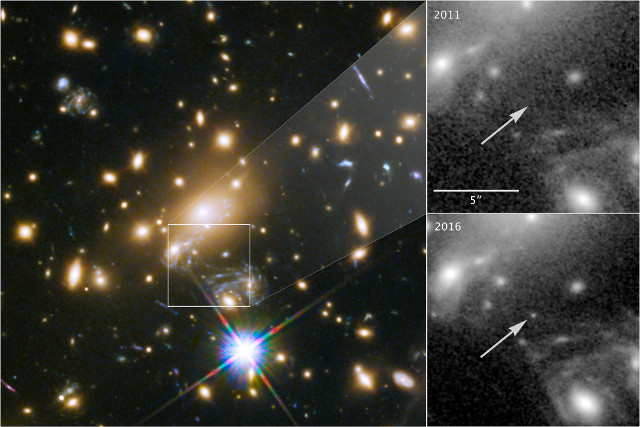
Icarus (MACS J1149+2223 Lensed Star 1)

An article published in the journal “Nature Astronomy” describes the observation of the most distant star and therefore also the oldest observed so far, nicknamed Icarus, about 9 billion light years from Earth. A team of researchers exploited a double gravitational lensing effect that magnified the image of the star, which was called MACS J1149+2223 Lensed Star 1 but for that reason it’s simply called Lensed Star 1 (LS1). That effect made it become bright enough to be detectable by the Hubble Space Telescope.

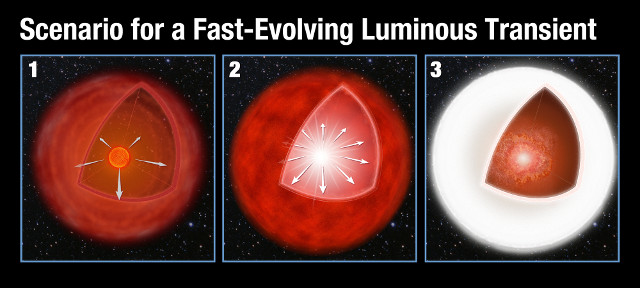
Scenario of a FELT event (Image NASA, ESA, and A. Feild (STScI) )

An article published in the journal “Nature Astronomy” describes a research that offers an explanation to a type of extremely bright event called Fast-Evolving Luminous Transient (FELT), that lasts just a few days. A team of researchers took advantage of the ability of NASA’s Kepler space telescope to accurately detect rapid changes in starlight to build a model in which a FELT event is caused by a large shell of gas and dust around a supernova, which makes it shine.

Artist's concept of the panorama on the planet TRAPPIST-1f (Image NASA/JPL-Caltech/T. Pyle (IPAC))

An article published in the journal “Nature Astronomy” describes a research into the possible migration of the orbits of the 7 planets of the ultra-cool dwarf star TRAPPIST-1’s system and their composition. A team of researchers from Arizona State University (ASU) and Vanderbilt University put together the information available on that system to perform a series of calculations concluding that the planets formed much farther away from their star from their current positions and that some of them have a very high water content, paradoxically too much for them to be habitable.

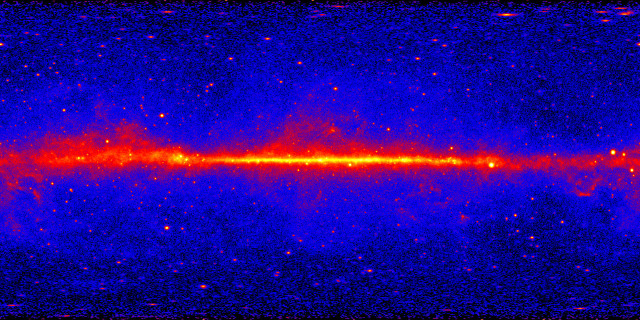
Map of high-energy Gamma Rays (Image NASA/DOE/Fermi LAT Collaboration)

An article published in the journal “Nature Astronomy” describes a research that indicates the origin in an anomalous gamma-ray source detected for the first time in 2009 by the NASA’s Fermi gamma-ray space telescope. One of the hypotheses concerned collisions of dark matter particles, instead according to a team of astronomers there are millisecond pulsars in the nucleus of the Milky Way whose emissions mixed up in the signal detected by Fermi.

Illustration of exoplanets orbiting red dwarfs

An article published in “The Astronomical Journal” shows the confirmation of 15 exoplanets that orbit red dwarfs. A team of researchers led by Teruyuki Hirano from the Tokyo Institute of Technology used data collected by NASA’s Kepler space telescope and follow-up observations. Another article in the same journal focuses on 3 confirmed super-Earths including K2-155d, which could be in ​​its system’s habitable zone.