
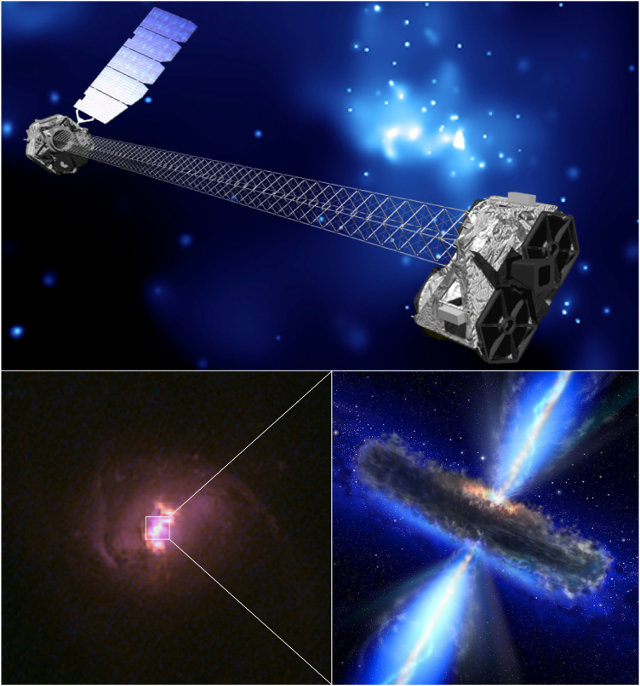
Yesterday at the Royal Astronomical Society’s National Astronomy Meeting (NAM2015), at the Venue Cymru centre in Llandudno, Wales, evidence were presented of the discovery of supermassive black holes found thanks to the NASA’s NuSTAR (Nuclear Spectroscopic Telescope Array) space telescope. An international team led by astronomers at the British Durham University detected the high energy X-ray emission from five black holes that were previously hidden by dust and gas.
George Lansbury, a researcher at Durham University and lead author of the study, to be published in “The Astrophysical Journal”, explained that astronomers suspected that there were many supermassive black holes hidden from sight. They lacked the instruments to be able to detect the ones so far hidden by dust and gas, which absorb even high energy electromagnetic radiation.
The NuSTAR space telescope, launched in June 2012, is perfect for this type of research because it can detect X-rays at energies much higher than previous satellites. These are the only electromagnetic radiation that can pass through the thick clouds of gas and dust obscuring the supermassive black holes that are the object of this research.
The researchers selected nine galaxies among the many candidates to host a supermassive black hole so far undetected. In five cases, the NuSTAR space telescope detected a signal of high-energy X-rays. Only a supermassive black hole can emit that type of electromagnetic radiation, confirming the predictions.
The observed objects were even more active than expected. The explanation is that there’s really a huge amount of dust and gas surrounding the supermassive black hole orbiting it and heating up a lot. It’s from this area, outside the black hole’s event horizon, that electromagnetic radiation even at very high energies come, still being able to escape the powerful gravity.
This research found only five hidden supermassive black holes but suggests that in the universe there are many more of them. The NuSTAR space telescope is allowing to greatly enhance our knowledge of these objects that influence the evolution of the galaxies that host them.

Permalink
Permalink
Permalink