
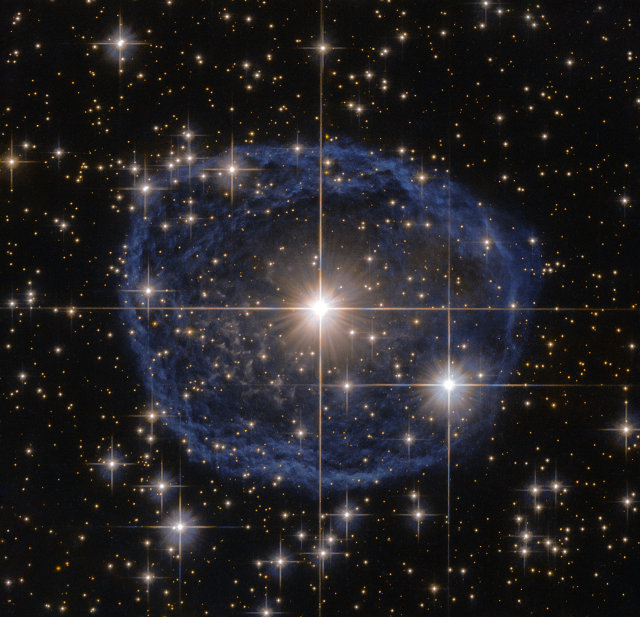
The Hubble Space Telescope took a picture of the star WR 31a, which has the characteristic of being surrounded by a bubble nebula. It’s estimated to have been created about 20,000 years ago by the impact of the strong stellar winds emitted by WR 31a and materials, especially hydrogen, ejected from it in the earlier stages of its life.
The star WR 31a, also known as Hen 3-519 or ESO 128-18, is about 30,000 light years away from Earth and belongs to the star category called a Wolf-Rayet after astronomers Charles Wolf and Georges Rayet who discovered the first specimens in 1867. Those are massive stars, born having at least twenty solar masses, which are ejecting a substantial amount of mass, at speeds like a billion times the mass ejected from the Sun in the same period.
A part of the Wolf-Rayet stars is accompanied by a nebula that surrounds them, is directly associated with them and for this reason is called Wolf-Rayet nebula. This type of nebula is often in the form of a ring or a sphere. This is the case of WR 31a, which has around it an exceptional blue nebula that is expanding very rapidly at an speed estimated around 220,000 km/h (136,700 mph).
Shows such as those offered by WR 31a and the other Wolf-Rayet stars are short-lived in astronomical terms. Such massive stars consume their hydrogen rapidly and to this must be added the problem that a part of their gas gets lost by ejecting it. The consequence is that these stars have a life cycle of a few hundreds of thousands of years that ends with a supernova.
This photograph of the star WR 31a was taken by the Hubble Space Telescope’s ACS (Advanced Camera for Surveys) instrument. It captured perfectly the spectacular nebula surrounding WR 31a offering us another memorable image. For astronomers this is another opportunity to study Wolf-Rayet stars and their chaotic life cycle to better understand their evolution.
[ad name=”eBayUSUKAstronomy”]

Permalink
If the nebula was formed 20,000 years ago and it is 30,000 light years away from us, wouldn’t it take another 10,000 years for us to see it?
Why do we see it now?
Permalink
I suspect someone involved with the description of the star nebula mixed up the temporal scales. Possibly the light from its birth reached us 20.000 years ago, which means that it was actually born 50.000 years ago considering its distance.