
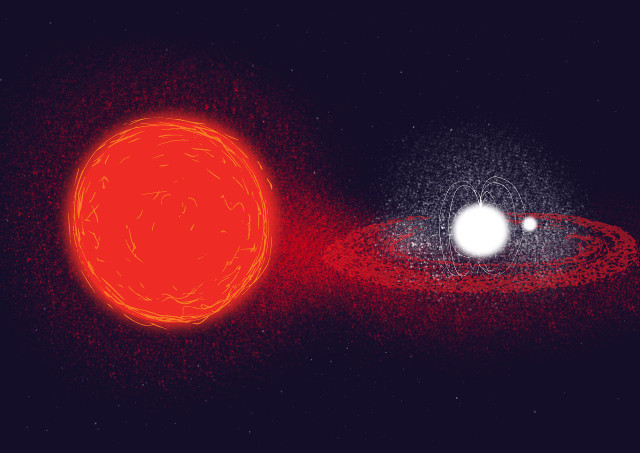
An article published in “The Astrophyiscal Journal” reports a study of the pulsar PSR J1023+0038, which showed a peculiar behavior given that for the first time both visible light and X-ray emissions were detected. A team of researchers led by Alessandro Papitto of the Italian National Institute of Astrophysics used the Galileo National Telescope in the Canaries and ESA’s XMM-Newton Space Telescope to capture the different emissions of what’s classified as a millisecond pulsar for its very fast rotation speed and offer an explanation to his behavior.
Millisecond pulsars are an extreme situation even for neutron star standards because they spin hundreds of times per second. This means that an object on the surface of a millisecond pulsar’s equator would travel at a speed around 10% of the speed of light. According to the models those spinning speeds are reached after billions of years of evolution in binary systems in which the pulsar has a companion and steal gas from it that forms an accretion disk that among other things slowly accelerates its spin.
Within the category of millisecond pulsars there’s an even more peculiar one, the transitional millisecond pulsars, which alternate in very few weeks pulsar phases with X-ray emissions with radio pulsar phases powered by the rotation of a very intense magnetic field. Alessandro Papitto started studying these strange pulsars to try to understand the working mechanisms already in 2013. Together with various collaborators he published a first study of the pulsar PSR J1023+0038 in the journal “Nature Astronomy” in October 2017. Several members of that team and new collaborators conducted the new study now published in “The Astrophyiscal Journal”.
Alessandro Papitto compared the PSR J1023+0038 pulsar to a lighthouse that together with rapid flashes of light also emits X-ray pulses in perfect sync. Filippo Ambrosino, another of the authors of the research and of the INAF, added that when the team he planned the observations he thought that the pulsar would oscillate between the optical pulsations and those of the X-rays changing its state very rapidly but in reality they occur simultaneously for tens of mintues, they go out and come back together again.
The existing models did not provide explanations for the behavior of the PSR J1023+0038 pulsar so the team of Alessandro Papitto proposed a new scenario to explain it. It is based on the emission of a strong electromagnetic wind that interacts with the accretion disk that surrounds the pulsar. When that wind hits the materials in the disk it creates a powerful shock wave that accelerates the electrons inside it at very high speeds. The electrons interact with the magnetic field of the wind producing a strong synchrotron radiation that can be observed simultaneously in the X-ray optical bands.
Alessandro Papitto compared the behavior of the shock region between the pulsar’s wind and the accretion disk to a screen in which energy is deposited that is rapidly emitted all at once, leading to the observed impulse in the optical bands and X-rays. In other pulsars the accretion disk reaches the surface but in PSR J1023+0038 the materials are destroyed by the electromagnetic wind at a distance of about 100 kilometers, therefore they don’t contribute to most of the X-ray emission and to the rotation speed.
The new model predicts a delay of a few hundred microseconds between the optical and the X-ray signals, and that needs to be confirmed by new, even more accurate, observations. These are complex measurements from a technical point of view and it will be useful to use again the SiFAP (Silicon Fast Astronomical Photometer) instrument installed on the Galileo National Telescope. The new version called SiFAP2, which saw the so-called first light on November 14, 2018, is even more versatile than the one used by Alessandro Papitto’s team for the studies of the PSR J1023+0038 pulsar and, together with the versatility of the XMM-Newton Space Telescope, could allow to carry out the required checks.
The pulsar PSR J1023+0038 confirmed to be a really interesting object for the interactions between accretion disk and magnetic field. The new discoveries made by Alessandro Papitto and his collaborators are bringing new information on these extreme objects.
