
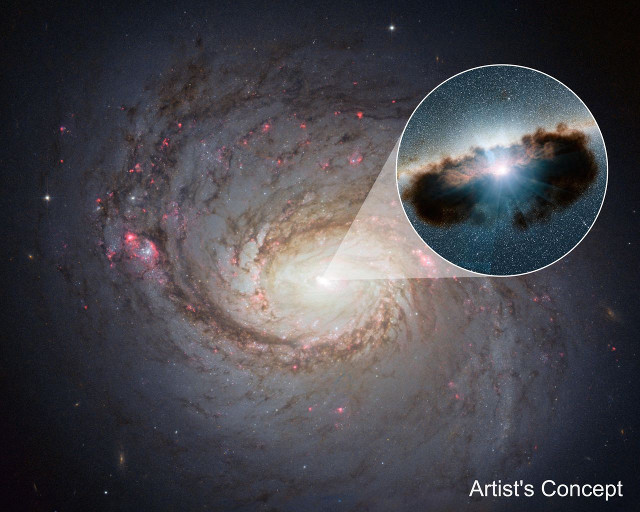
An article published in the journal “Monthly Notices of the Royal Astronomical Society letters” describes a research on the supermassive black hole at the center of the galaxy NGC 1068. An international team of astronomers led by Andrea Marinucci of the Roma Tre University in Italy used ESA’s XMM-Newton and NASA’s NuSTAR space telescopes to study the giant doughnut-shaped structure around the supermassive black hole.
Several supermassive black holes are surrounded by disks of gas and dust that form a sort of doughnut. These materials get slowly swallowed but sometimes they’re so dense that hide these black holes’ activity and until recently there were no instruments that could see through these disks.
The NuSTAR space telescope, launched in June 2012, is perfect for this type of research because it can detect X-rays at energies much higher than previous satellites. These are the only electromagnetic radiation that can pass through the thick clouds of gas and dust obscuring supermassive black holes. Some months ago, a specific research discovered some of them thanks to this possibility.
The galaxy NGC 1068, also known as M77, is about 47 million light years from Earth. Between 2014 and 2015, the supermassive black hole at its center was observed with the XMM-Newton and NuSTAR space telescopes thanks to the X-rays emitted in the area that surrounds it. NuSTAR can detect X-rays at energies hither than XMM-Newton and in August 2014 found a peak of brightness.
The disk around the supermassive black hole in the galaxy NGC 1068 is one of the thickest discovered so far but the astronomers who conducted this research think that its structure is not homogeneous. Andrea Marinucci compared it with a partly cloudy day when the clouds move quickly so that there’s more or less sunlight at different moments.
The heterogeneity of this disk is not a surprise but it’s the first time it is observed in such a thick structure. It’s a step forward in understanding the growth and evolution of supermassive black holes and their galaxies but additional studies are needed to have all the answers.
In particular, the next investigation will focus on the possible causes of these heterogeneity. It might be caused by the supermassive black hole that generates turbulence while swallowing gas and dust. The cause may be instead in external causes such as young stars nearby. The gravity of these black holes significantly influences the evolution of their host galaxies so these studies are considered very interesting.
[ad name=”eBayUSUKNASA”]

Permalink