Telescopes

The FRB 190520B fast radio burst area (in red) as seen by the VLA radio telescope (Image Niu, et al.; Bill Saxton, NRAO/AUI/NSF; CFHT)

An article published in the journal “Nature” reports the identification of a new fast radio burst which was cataloged as FRB 190520B. A team of researchers made this discovery thanks to the FAST radio telescope in China. Recently, the number of known fast radio bursts has increased significantly but in this case, it’s a repeating phenomenon that makes it rare and particularly interesting. FRB 190520B has characteristics that are different from other fast radio bursts because it repeats, just like the one cataloged as FRB 121102. Magnetar-type neutron stars are the most likely candidates as sources of these emissions and the magnetar that generates FRB 190520B may have just formed after a supernova.

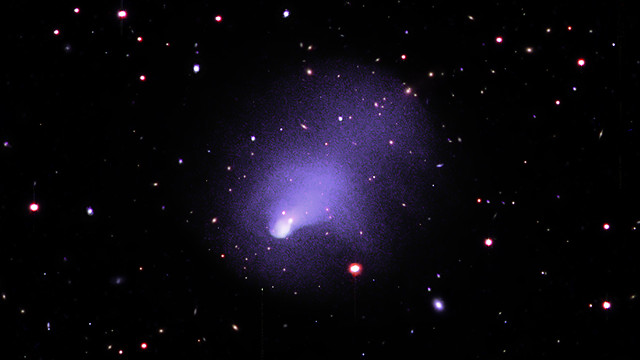
Abell 2146 seen at X-rays by the Chandra X-ray Observatory (Image NASA/CXC/Univ. of Nottingham/H. Russell et al.; Optical: NAOJ/Subaru)

An article accepted for publication in the journal “The Monthly Notices of the Royal Astronomical Society” reports the results of the observations of Abell 2146, composed of two galaxy clusters in their merger phase. A team of researchers led by Helen Russell of the British University of Nottingham used NASA’s Chandra X-ray Observatory to study the shock wave that formed along the collision between the two clusters and is about 1.6 million light-years long. The processes in place show similarities with others that occur on a much smaller scale such as those generated by the solar wind.

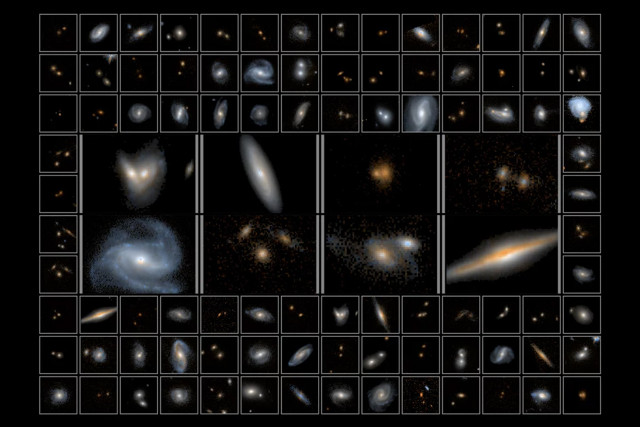
Some of the galaxies observed in the 3D-DASH survey

An article accepted for publication in “The Astrophysical Journal” reports the release of the results of the 3D-DASH survey, which aims to map star-forming regions to understand the formation of the most ancient galaxies, which from the Earth’s point of view are the most distant. A team of researchers used the Hubble Space Telescope to capture near-infrared images in the area known as the COSMOS (Cosmic Evolution Survey) field, a previous survey conducted with Hubble.

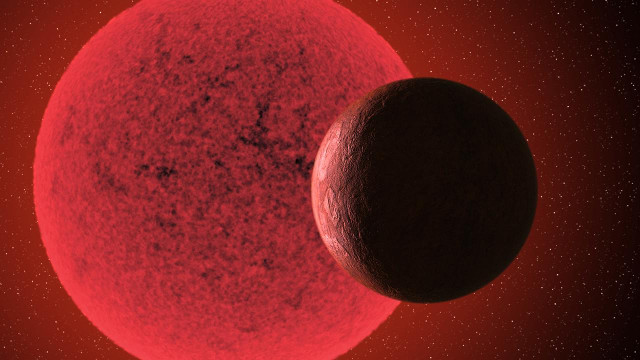
Artist's concept of a super-Earth orbiting close to a red dwarf (Image courtesy Gabriel Pérez Díaz, SMM (IAC))

An article accepted for publication in the journal “Publications of the Astronomical Society of Japan” reports the discovery of the exoplanet Ross 508 b, probably a super-Earth at the edge of ​​its star system’s habitable zone. A team of researchers led by Hiroki Harakawa used the IRD (InfraRed Doppler) instrument mounted on the Subaru Telescope to examine the star Ross 508, a red dwarf that has a mass that is only 18% of the Sun’s. The radial velocity method allowed to identify what from the collected data looks like a rocky planet with a mass that is about 4 times the Earth’s. This discovery confirms the value of infrared spectroscopic examinations of red dwarfs.

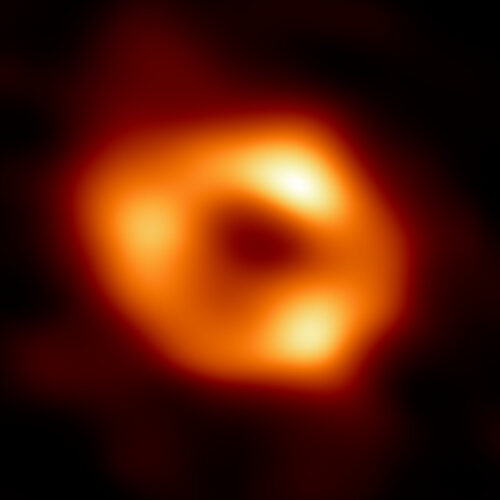
The area around Sagittarius A* (Image courtesy EHT Collaboration)

In various press conferences, representatives of the institutions collaborating in the Event Horizon Telescope (EHT) project announced that they obtained the first image of the area around Sagittarius A*, the supermassive black hole at the center of the Milky Way. The central shadow, which constitutes the black hole, is surrounded by a sort of ring formed by gas and dust that glow because they were heated by Sagittarius A*. It took the combination of 8 radio telescopes to obtain proof of the existence of this supermassive black hole, taken for granted by the vast majority of scientists but still denied by some.