Telescopes

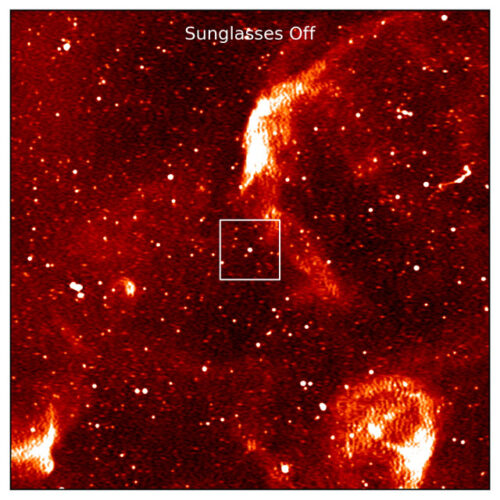
The pulsar PSR J0523-7125 in the square seen by MeerKAT (Image courtesy Yuanming Wang)

An article published in “The Astrophysical Journal” reports the discovery of a pulsar cataloged as PSR J0523-7125, the brightest pulsar discovered outside the Milky Way. A team of researchers led by Tara Murphy of the Australian University of Sydney used a new technique based on the analysis of the polarization of the light emitted by the pulsar to identify it among the observations conducted with the ASKAP radio telescope. The polarization was crucial in the identification because it made it possible to understand that the light came from a pulsar and not from an object of another type.

The galaxies NGC 1385, NGC 1566, NGC 3344, and NGC 6503

An article published in “The Astrophysical Journal” reports the results of a study conducted on 108 galaxies containing nuclear star clusters in search of intermediate-mass black holes. A team of researchers used NASA’s Chandra X-ray Observatory to look for the traces of this type of black hole that has so far been very elusive. In 29 of these galaxies, they found emissions they believe came from this type of black hole and traces of the destruction of thousands of stars. This suggests that intermediate-mass black holes grow by devouring stars.

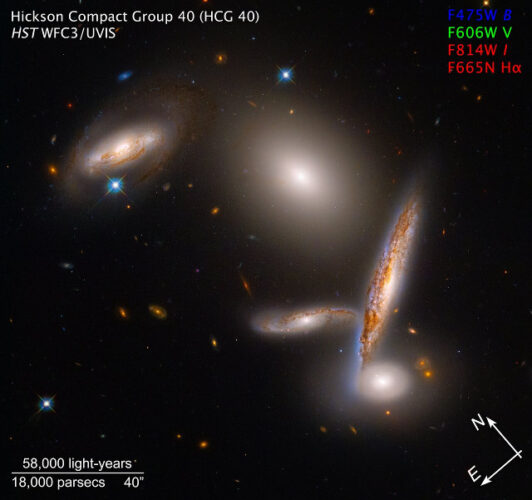
Hickson Compact Group 40 (HCG 40)

April 25, 2022, will mark the 32nd anniversary of the Hubble Space Telescope’s deployment into orbit, and to celebrate it, NASA and ESA have published images of a quintet of galaxies known as Hickson Compact Group 40 (HCG 40). This group of three spiral galaxies, one elliptical galaxy, and one lenticular galaxy is interesting for a number of reasons including the fact that within about a billion years they are predicted to collide and start merging.

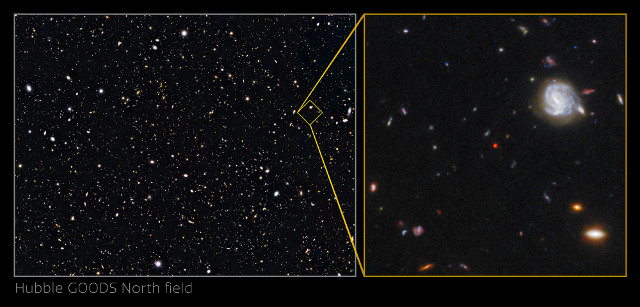
GNz7q with the likely supermassive black hole precursor in red

An article published in the journal “Nature” reports the discovery of a possible precursor of a supermassive black hole in the early universe. A team of researchers discovered the object cataloged as GNz7q in the data of the GOODS survey conducted by combining observations made with different telescopes. From Earth, we see GNz7q as it was about 750 million years after the Big Bang and its emissions can only be partially explained by a remarkable star formation. The conclusion is that there’s probably a supermassive black hole growing within the dust that fills up the primordial galaxy’s nucleus and over time it will become a quasar, a type of extremely bright active galactic nucleus.

Artist's concept of RS Ophiuchi showing the white dwarf stealing gas from its companion (Image courtesy DESY/H.E.S.S., Science Communication Lab)

An article published in the journal “Nature Astronomy” reports a study of the recurrent nova known as RS Ophiuchi based on the detection of the gamma rays emitted by the last outburst that occurred on the white dwarf part of the pair. MAGIC Collaboration researchers examined data collected by the MAGIC telescopes and concluded that outbursts of that type generate some of the gamma rays present in the Milky Way.