Telescopes

Comet C/2014 UN271 (Bernardinelli-Bernstein)

An article published in “The Astrophysical Journal Letters” reports a study on comet C/2014 UN271 (Bernardinelli-Bernstein) conducted thanks to observations made with the Hubble Space Telescope. A team of researchers also used previous observations to estimate that this comet’s nucleus is about 119 kilometers in diameter. This result confirms that it’s the largest known comet. The studies will continue even if it will remain very far from Earth also because it almost certainly comes from the Oort cloud.

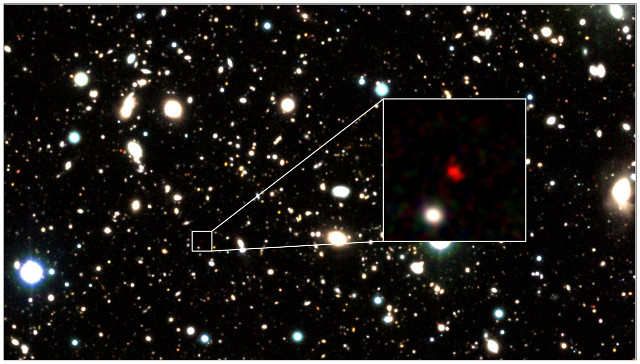
HD1 in the zoom-in image (Image courtesy Harikane et al.)

An article published in “The Astrophysical Journal” reports the discovery of what could set the new record for the most distant known galaxy. A team of researchers used various telescopes to observe this object, cataloged as HD1, whose distance has been estimated to be about 13.5 billion light-years from Earth.

In another article, published in the journal “Monthly Notices of the Royal Astronomical Society Letters”, some of the researchers offer some theories about HD1. It could be a so-called starburst galaxy with an extraordinary star formation star which could include the first generation of stars in the universe or a quasar powered by the oldest known supermassive black hole.

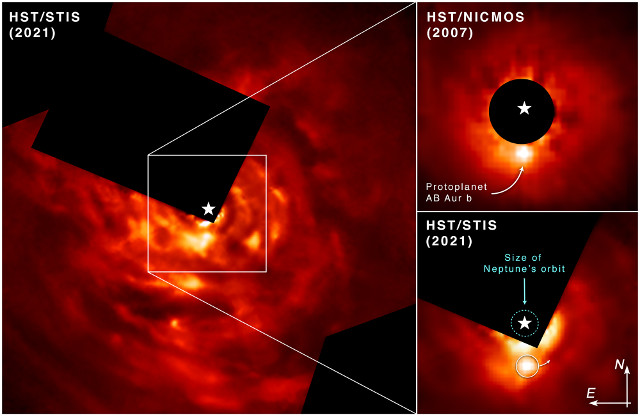
The AB Aurigae system and its protoplanet seen by Hubble

An article published in the journal “Nature Astronomy” reports a study on the protoplanet cataloged as AB Aurigae b, a gas giant that is growing following an unusual process called disk instability. A team of researchers used observations made with the Hubble Space Telescope and the Subaru Telescope on Mauna Kea, Hawaii, between 2007 and 2021 to find evidence of that violent formation. Proving that gas giants can form as a result of disk instability will help better understand the history of the solar system as well.

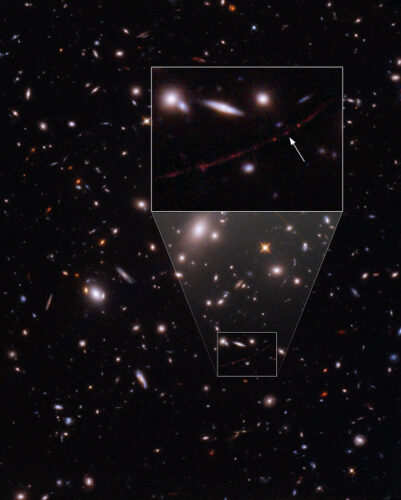
Earendel, indicated by an arrow, seen by Hubble (Image NASA, ESA, B. Welch (JHU), D. Coe (STScI), A. Pagan (STScI) )

An article published in the journal “Nature” reports the discovery of the most distant single star, nicknamed Earendel. A team of researchers used data collected during the RELICS (Reionization Lensing Cluster Survey) program using the Hubble Space Telescope to search for the brightest galaxies dating back to the first billion years of the universe’s life. A large galaxy cluster cataloged as WHL0137-08 distorted the image of very distant galaxies in a gravitational lensing effect to the point that it can detect a single star about 12.9 billion light-years away from Earth. Earendel’s study, whose mass was estimated to be at least 50 times the Sun’s, will help to better understand the formation and evolution of the very first generations of stars in the universe.

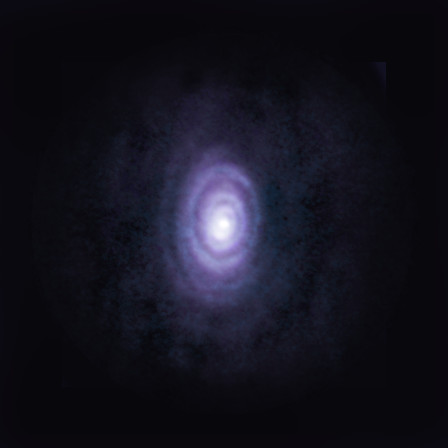
The star V Hydrae and its rings seen by ALMA (Image ALMA (ESO/NAOJ/NRAO)/S. Dagnello (NRAO/AUI/NSF))

An article accepted for publication in “The Astrophysical Journal” reports the results of a study of the star V Hydrae that includes the discovery of a system of six rings that surround it and are expanding and two hourglass structures. A team led by Raghvendra Sahai of NASA’s JPL used the ALMA radio telescope and data collected with the Hubble Space Telescope to study the materials that were ejected by V Hydrae in the agony that will lead to its death. These observations can provide valuable information to better understand the processes taking place during a relatively short phase that for this reason is difficult to observe.