Telescopes

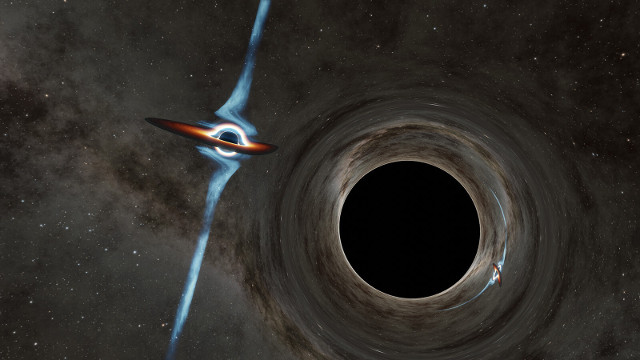
Artist's concept of the blazar PKS 2131-021 with its pair of supermassive black holes (Image courtesy Caltech/R. Hurt (IPAC))

An article published in “The Astrophysical Journal Letters” reports a study on the blazar cataloged as PKS 2131-021 that offers evidence that it contains a pair of supermassive black holes orbiting each other in a period of two years. A team of researchers used data collected from different telescopes with radio observations going back in time to 1975 to reconstruct what happens inside PKS 2131-021 by exploiting its nature as a blazar. That’s because, by definition, a blazar is powered by a supermassive black hole that emits a jet of materials at very high speeds oriented towards the Earth. The examination of the jet from PKS 2131-021 showed movement caused by the orbital movements of the black hole and a companion around each other. According to the researchers, from the Earth’s point of view, these two supermassive black holes will merge in about 10,000 years.


The galaxy cluster Abell 3667

An article published in the journal “Astronomy & Astrophysics” reports the most detailed view ever obtained of remains inside the galaxy cluster Abell 3667 with a shock wave that expands over about 6.5 million light-years, the largest ever identified. A team of researchers led by Francesco de Gasperin of the Italian National Institute of Astrophysics used the MeerKAT radio telescope to obtain detailed images of a shock wave generated by the collision between two galaxy clusters that occurred over a billion years ago.

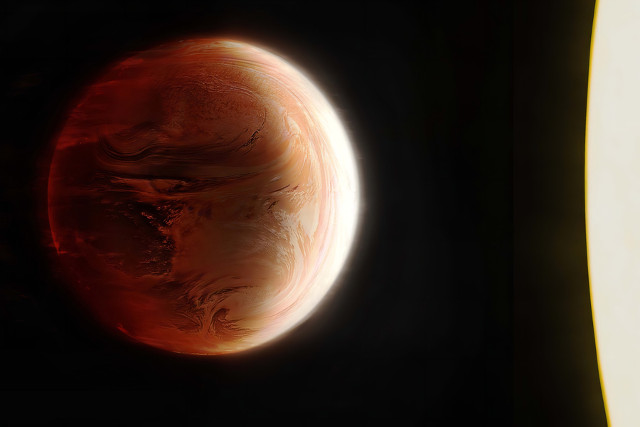
Artist's concept of the exoplanet WASP-121b (Image Engine House VFX)

An article published in the journal “Nature Astronomy” reports the results of a new study on the exoplanet WASP-121b, an ultrahot Jupiter considered one of the planets with the most extreme conditions known. A team of researchers led by Tom Evans, today at the Max Planck Institute for Astronomy in Heidelberg, Germany, used data collected by the Hubble Space Telescope to investigate compounds present in WASP-121b’s atmosphere. The conclusion is that there may be clouds of iron, titanium, and corundum, the crystallized form of aluminum oxide that makes up rubies and sapphires.

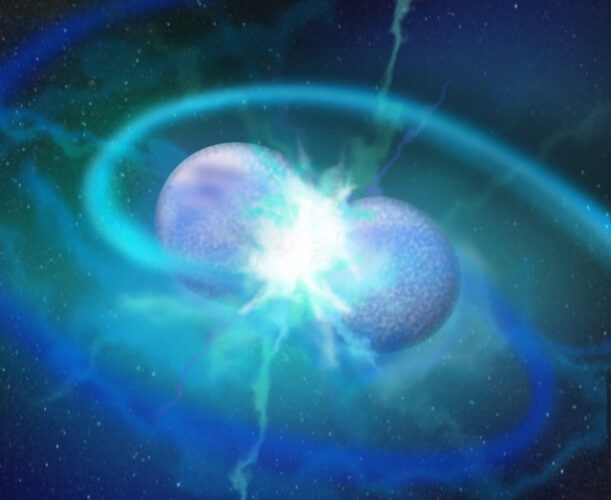
Artist's concept of two white dwarf merging (Image Nicole Reindl (CC BY 4.0))

Two articles published in the journal “Monthly Notices of the Royal Astronomical Society: Letters” report different aspects of a study on two anomalous stars, as they’re two subdwarfs that have carbon and oxygen on the surface instead of hydrogen and helium. A team led by Professor Klaus Werner of the German University of Tübingen discovered the two stars, cataloged as PG 1654+322 and PG 1528+025 as part of a research aimed at better understanding the final stages of stellar evolution. A team led by Dr. Miller Bertolam of the Institute of Astrophysics of La Plata, Argentina, offered a possible explanation for the two anomalous stars by explaining in one of two articles that they could have formed as a result of mergers between two white dwarfs.

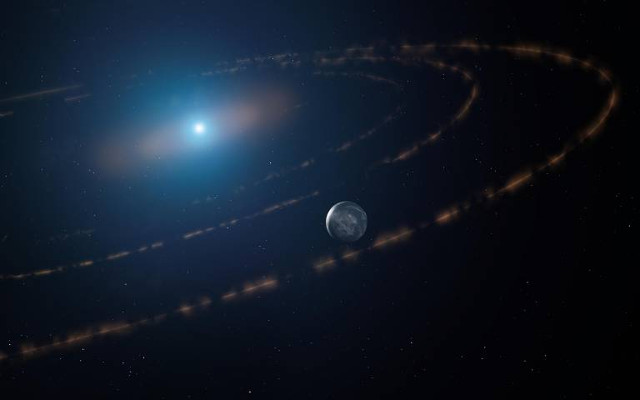
Artist's concept of WD1054-226's system (Image courtesy Mark A. Garlick / markgarlick.com)

An article published in the journal “Monthly Notice of the Royal Astronomical Society” reports the observation of debris orbiting the white dwarf cataloged as WD1054-226 in a formation that suggests a gravitational bond such as the one which can be generated by a planet. A team of researchers used the ULTRACAM camera mounted on ESO’s NTT telescope at La Silla Observatory in Chile to examine objects that regularly pass in front of those star remnants. Data obtained from NASA’s TESS space telescope helped identify what appears to be a disk of debris that hasn’t dispersed, perhaps thanks to a planet acting as a sort of shepherd that keeps them bound. The planet would be in ​​that system’s habitable area, a special case since it has a white dwarf at its center.