Telescopes

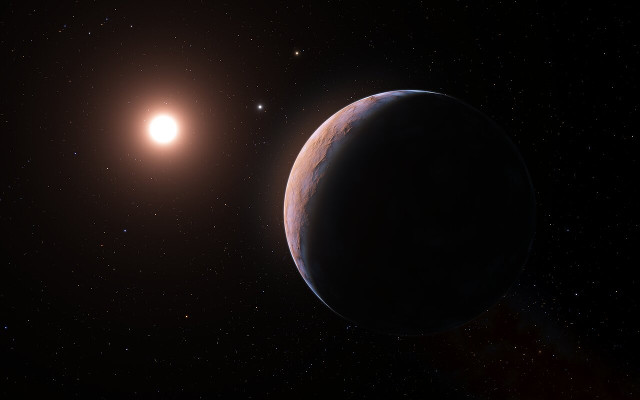
Artist’s impression of Proxima d and Proxima Centauri (Image ESO/L. Calçada)

An article published in the journal “Astronomy & Astrophysics” reports the discovery of another rocky planet in the Proxima Centauri system. A team of researchers led by João Faria of the Instituto de Astrofísica e Ciências do Espaço, Portugal, used detections conducted with the ESPRESSO spectrograph mounted on ESO’s VLT in Chile to find the traces of the planet that was cataloged as Proxima d. This is the exoplanet with the smallest mass identified with the radial velocity method since the estimated minimum mass is about a quarter of the Earth’s, twice Mars’s. Its distance from Proxima Centauri is around 4 million kilometers, so it’s more similar to Venus or Mercury.

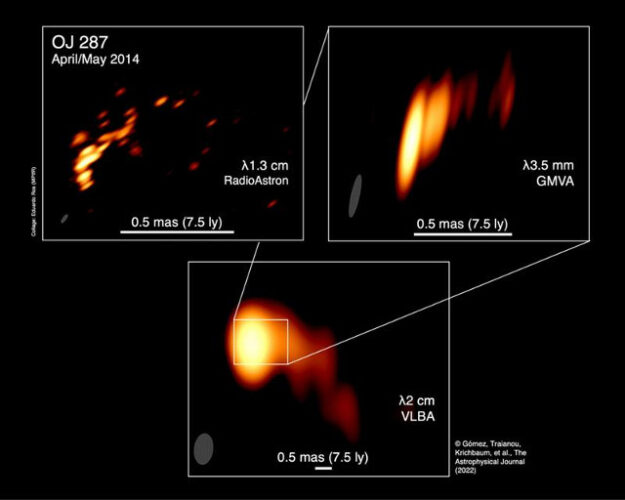
The blazar OJ 287 observed at different wavelengths by RadioAstron, GMVA, and VLBA

An article published in “The Astronomical Journal” reports observations of the blazar OJ 287 conducted by combining different radio telescopes in various areas of the world and the RadioAstron antenna in space. A team of researchers obtained in this way the highest resolution images obtained so far of OJ 287. They confirm the presence of two supermassive black holes powering the active galactic nucleus, one of the reasons why this blazar has been the focus of many scientists’ interest for a long time.

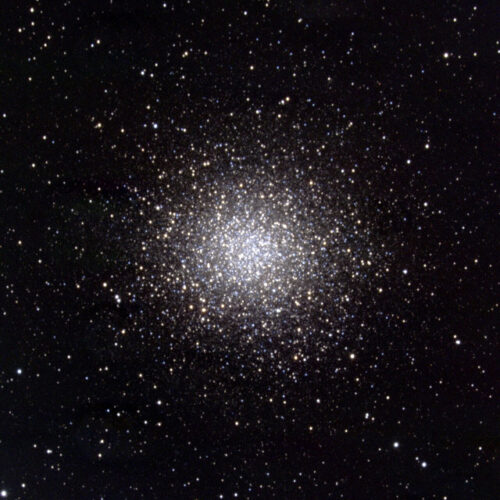
The globular cluster M14 (Image NOIRLab/NSF/AURA)

An article published in “The Astrophysical Journal” reports the results of observations of the globular cluster M14. A team of astronomers led by Francesca D’Antona of the Italian National Institute of Astrophysics, Rome, used the Hubble Space Telescope to study M14, discovering that over a third of the stars in M14 contains an amount of helium never observed outside globular clusters, as it has peaks higher than 30% of their mass. According to the researchers, the most likely explanation is that these are second-generation stars that swallowed the helium ejected by first-generation stars during their agony.

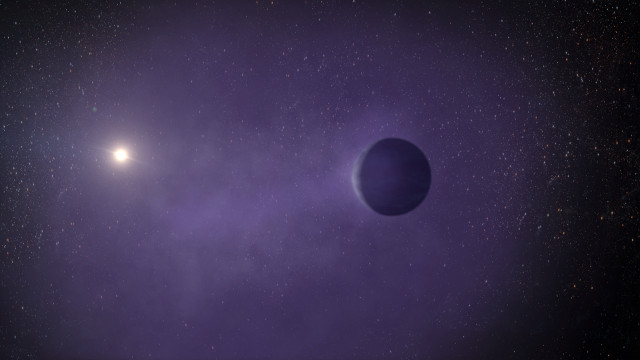
Artist's concept of the exoplanet TOI 560.01 with its star (Image Adam Makarenko (Keck Observatory))

Two articles published in “The Astronomical Journal” report studies on as many exoplanets of the mini-Neptune type that are losing their atmosphere. Two teams led by Michael Zhang with other members in common used the Hubble Space Telescope to study the exoplanet HD 63433c and the Keck Observatory in Hawaii to study the exoplanet TOI 560.01, also known as HD 73583b. In both cases, the XMM-Newton space telescope was used to study the high-energy emissions from their stars and from the outflow of gas from their atmospheres. Observations of gas leaking into space is a confirmation of the theory that mini-Neptunes can transform into super-Earths at the end of that loss.

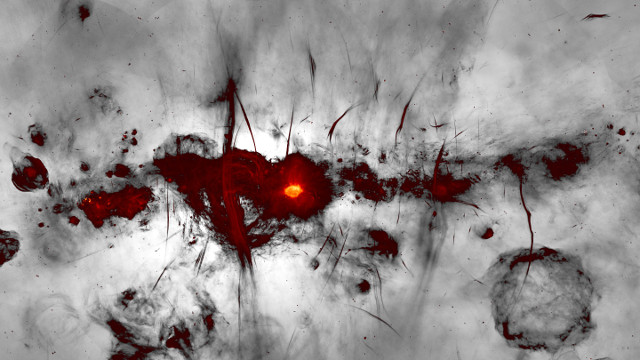
The Milky Way center as seen by MeerKAT

Two articles accepted for publication, one in “The Astrophysical Journal” and one in “The Astrophysical Journal Letters”, report different aspects of a study on the Milky Way’s center. A team of researchers used the MeerKAT radio telescope to examine the galactic center with a clarity and depth never obtained before. This made it possible to obtain new information on radio bubbles, supernova remnants, star nurseries, the region around the supermassive black hole at the center of the Milky Way, and many radio filaments.