Telescopes

The Andromeda galaxy (M31) with the cluster B023-G078

An article published in “The Astrophysical Journal” reports the discovery of a rare intermediate-mass black hole in the Andromeda galaxy at the center of what could be a stripped nucleus, what remains of a galaxy swallowed by Andromeda. A team of researchers observed the star cluster cataloged as B023-G078 at the Gemini Observatory and with the Hubble Space Telescope to calculate the mass distribution within it, a crucial step to understand its nature as a stripped nucleus and identify the intermediate-mass black hole. This could be a way to discover this rare type of black hole, which some models claim merges with others to form supermassive black holes following galaxy mergers.

The Eta Carinae system

A new image portrays Eta Carinae bringing together observations in various bands of the electromagnetic spectrum from infrareds to X-rays thanks to the Hubble, Chandra, and Spitzer space telescopes. Each frequency offers some specific data on this pair of stars especially famous for the so-called Great Eruption that made it particularly bright for many years with a peak in 1843. The data put together also allowed to create 3D models of the Homunculus Nebula and gas and dust clouds surrounding the pair. This is useful research for astronomers to understand the evolution of Eta Carinae and also from an educational point of view within NASA’s Universe of Learning program.

The dwarf galaxy Henize 2-10

An article published in the journal “Nature” reports a study on the dwarf galaxy Henize 2-10 that offers evidence that the supermassive black hole at its center stimulated star formation. Zachary Schutte and Amy Reines relied on observations conducted with the Hubble Space Telescope to find a kind of hot gas bridge that connects the black hole to a region of intense star formation and to connect the black hole’s outflow to that star nursery. These conclusions are useful to understand the influence of supermassive black holes on their host galaxies and their origin.

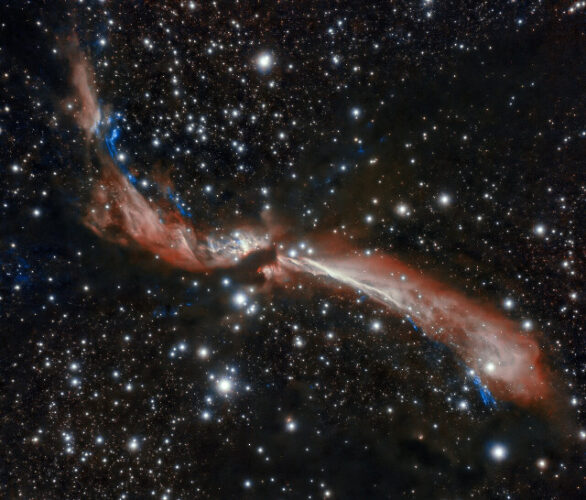
The jet MHO 2147 (Image International Gemini Observatory/NOIRLab/NSF/AURA. Acknowledgments: PI: L. Ferrero (Universidad Nacional de Córdoba))

An article published in the journal “Astronomy and Astrophysics” reports observations of stellar jets cataloged as MHO 2147 and MHO 1502 emitted by two protostellar sources. A team of researchers used the Gemini South telescope in Chile to study those jets, which have an appearance that is likely influenced by the gravitational pull of companion stars. The quality of the observations is due to the adaptive optics system designed to compensate for the distortion caused by the Earth’s atmosphere.

A composite image of the central area of ​​the Shapley Concentration within the Shapley supercluster

An article accepted for publication in the journal “Astronomy & Astrophysics” reports the observations of an interaction within the Shapley supercluster, one of the largest known structures in the universe, with collisions between galaxies within it. A team of researchers used in particular observations conducted with three radio telescopes: the Australian ASKAP, the South African MeerKat, and the Indian GMRT. That data was complemented with optical frequency observations conducted with the VST in Chile and X-ray observations with NASA’s XMM-Newton space telescope. Galaxy merger processes are occurring among relatively small groups but offer information on consequences at various scales, with influences even on large structures of galaxy clusters.