Telescopes

The Flame Nebula with the NGC 2023 nebula on the right (Image ESO/Th. Stanke)

An article accepted for publication in the journal “Astronomy & Astrophysics” reports an overview of the first results of an astronomical survey called ALCOHOLS concerning the Orion Molecular Cloud Complex. For the occasion, ESO released images of the Orion Flame Nebula, one of the star formation areas within that complex. Researchers led by former ESO astronomer Thomas Stanke used the SuperCam instrument mounted on the APEX radio telescope to map the presence of carbon monoxide in that area. Despite its name and what it looks like in the images, the Flame Nebula is very cold, with temperatures generally just a few degrees above absolute zero.

The galaxy NGC 1515 and other objects seen by DECam

An image composed of data collected by the DECam (Dark Energy Camera) shows a group of spiral galaxies with NGC 1515 in the center. It’s a galaxy considered part of the so-called Dorado Group, a set of galaxies with gravitational bonds that are not numerous enough to be defined as a galaxy cluster. Other spiral galaxies included in the image are at various distances from Earth and the farthest are indistinguishable to the naked eye from Milky Way stars present in that area of ​​the sky.

The galaxy Centaurus A seen by the WMA (Image Ben McKinley, ICRAR/Curtin and Connor Matherne, Louisiana State University)

An article published in the journal “Nature Astronomy” reports the observation of a cosmic eruption in the galaxy Centaurus A which, despite being about 12 million light-years away, has an extension in the Earth’s sky equivalent to that of 16 full Moons side by side. A team of researchers used the MWA radio telescope to detect the radio emissions generated by the supermassive black hole at the center of Centaurus A. The observations show a gigantic bipolar outflow with unprecedented quality. This allowed confirming a new interdisciplinary theory known as CCA (Chaotic Cold Accretion) regarding the interaction between the gas halos possessed by galaxies and the supermassive black holes they host.

The James Webb Space Telescope blasting off atop an Ariane 5 ECA rocket (Image NASA TV)

A little while ago, the James Webb Space Telescope was launched atop an Ariane 5 ECA rocket from the Kourou base, French Guiana. After about 27 minutes it successfully separated from the rocket’s last stage and began its journey to the area known as L2, about 1.5 million kilometers from Earth. During the journey, its structure will be deployed and instrument tests and calibrations will begin. That’s a long preparation phase that will continue even after the telescope has reached its destination. The launch has put a strain on the possibilities of one of the most powerful and reliable rockets available but was only the first in a series of critical steps required to begin the work of this extremely sophisticated instrument.

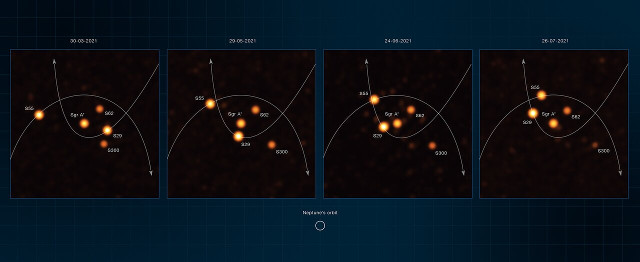
Some of the stars orbiting Sagittarius A*

Two articles published in the journal “Astronomy & Astrophysics” report aspects of a research on Sagittarius A*, the supermassive black hole at the center of the Milky Way. The GRAVITY collaboration and other researchers used ESO’s VLTI in Chile to observe stars around Sagittarius A* at a magnification 20 times greater than what was possible before the VLTI. This enabled to discover another star relatively close to the supermassive black hole, and by examining the orbit of that and other stars in that area, they estimated the mass of Sagittarius A* with greater precision.