Telescopes

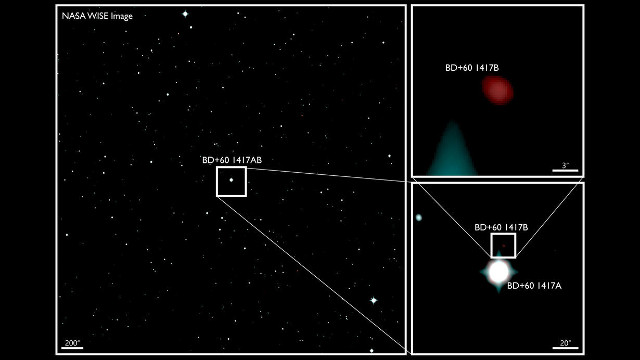
BD+60 1417's system

An article published in “The Astrophysical Journal” reports the discovery of an object orbiting BD+60 1417, a young star a little smaller than the Sun, which could be a gas giant planet but also a small brown dwarf. Amateur astronomer Jörg Schümann spotted a moving object by examining images in the “Backyard Worlds: Planet 9” program that anyone can participate in. A team led by Jackie Faherty of the American Museum of Natural History used various telescopes to confirm the existence of the object, cataloged as CWISER J124332.12+600126.2 or simply W1243. Its mass was estimated between 10 and 20 times the planet Jupiter’s, around the border between planet and brown dwarf, estimated around 13 Jupiter masses. The object had escaped previous research probably because its distance from its star is about 1660 times that of the Earth from the Sun.

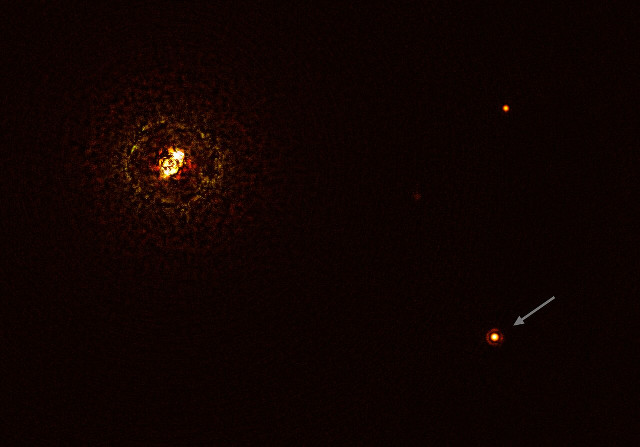
b Centauri's system seen by SPHERE

An article published in the journal “Nature” reports the discovery of a planet in the binary system b Centauri, the most massive in which a planet has been discovered. A team of researchers used ESO’s VLT in Chile to locate the exoplanet cataloged as b Centauri (AB)b or simply b Centauri b photographing it with the SPHERE instrument. It’s a record-breaking planet also because it has a mass estimated at about ten times Jupiter’s, making it one of the most massive known planets, with an orbit that is about one hundred times farther from the two stars than Jupiter’s distance from the Sun. The researchers think that b Centauri b likely formed in another area of its system and then moved due to gravitational interactions.

The IXPE space telescope blasting off atop a Falcon 9 rocket (Photo NASA/Joel Kowsky)

A few hours ago, the NASA and Italian Space Agency IXPE space telescope was launched on a Falcon 9 rocket from the Cape Canaveral base. After just over 33 minutes it successfully separated from the rocket’s last stage and made the necessary maneuvers to enter an equatorial orbit at an altitude of about 600 kilometers. There, after having extended its structure and after the test phase, it will begin its scientific mission to measure the polarization of cosmic X-rays, the first instrument of this type.

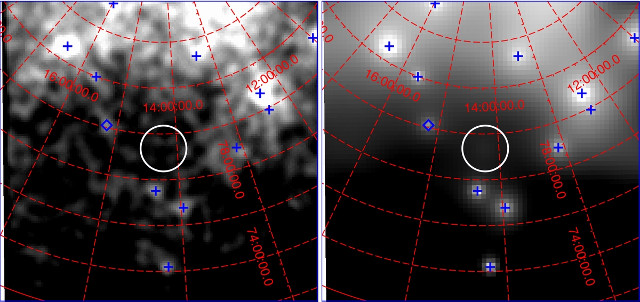
The area around Calvera (in the circle) observed by the Fermi space telescope's LAT instrument

An article accepted for publication in “The Astrophysical Journal” reports a study on the pulsar cataloged as 1RXS J141256.0+792204 and nicknamed Calvera, a reference to the movie “The Magnificent Seven” due to the fact that it’s an isolated pulsar like the previously known ones, nicknamed the magnificent seven. A team of researchers from the Italian National Institute of Astrophysics and the University of Padua used the NICER instrument on the International Space Station to study Calvera. The conclusions are that this pulsar is in the Milky Way’s halo, much farther than estimated after its discovery, and is much younger than the magnificent seven.

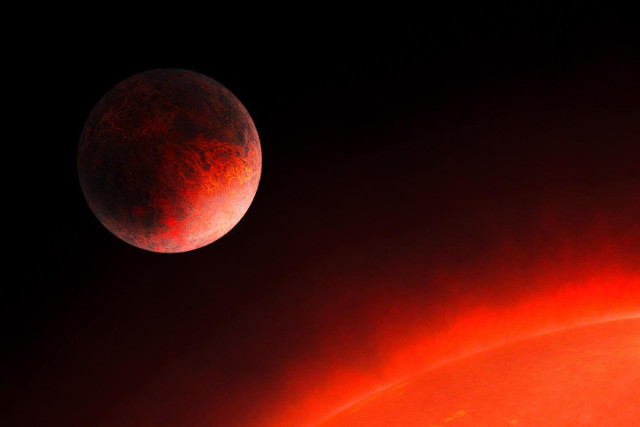
Artist impression of exoplanet GJ 367 b (Image courtesy SPP 1992 (Patricia Klein))

An article published in the journal “Science” reports the discovery of the exoplanet GJ 367 b, about the size of Mars, with a year lasting only eight hours. A team of researchers led by Kristine Lam and Szilárd Csizmadia of DLR, the German aerospace agency, used observations conducted by NASA’s TESS space telescope and follow-up detections conducted with the ESO’s 3.6-meter telescope in La Silla, Chile’s HARPS instrument to obtain information on GJ 367 b. You could say that it’s a super-Mercury since the two planets have a similar iron core but on the side of GJ 367 b facing its star, a red dwarf, the estimated temperature is about 1,500° Celsius.