Telescopes

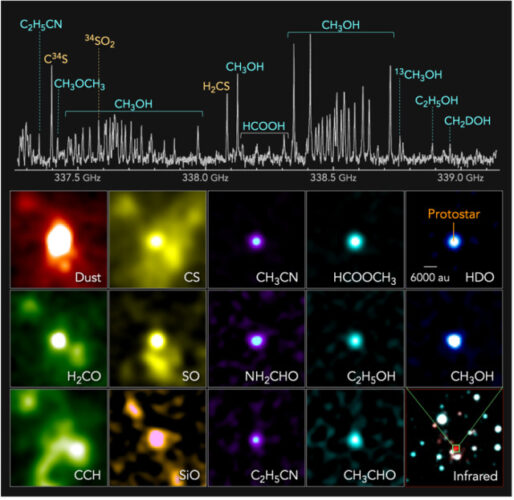
The traces of various molecules in the protostar's emissions seen by ALMA along with an infrared view

An article published in “The Astrophysical Journal” reports the discovery of complex organic molecules around a protostar at the edge of the Milky Way. A team of researchers led by astronomer Takashi Shimonishi of the Niigata University, Japan, used the ALMA radio telescope to examine the area around a protostar in the region cataloged as WB89-789 detecting the presence of molecules such as methanol, ethanol, methyl formate, dimethyl ether, formamide, propanenitrile, and others. This is the first time that complex organic molecules, the kind that can form prebiotic molecules, have been discovered at the edge of the Milky Way, and this suggests that they can form with an efficiency similar to that existing within the galaxy, in the Sun’s “neighborhood”.

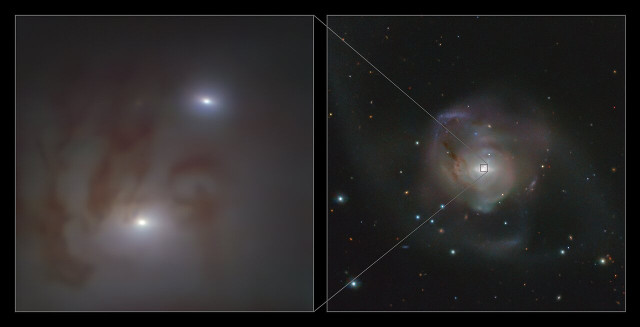
The galaxy NGC 7727 and its pair of supermassive black holes seen by the VLT

An article published in the journal “Astronomy & Astrophysics” reports the detection of a pair of supermassive black holes in the galaxy NGC 7727. A team of researchers used ESO’s VLT to conduct the observations that led to a discovery that broke two records in this field. The two supermassive black holes are the closest pair discovered so far at about 89 million light-years from Earth and are the closest to each other, as their distance was estimated to be around 1,600 light-years.

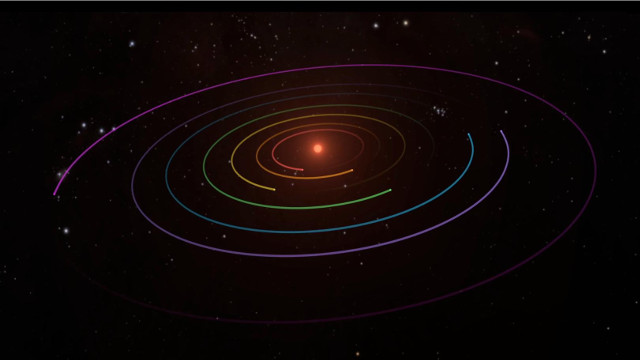
Scheme of TRAPPIST-1 planets' orbits (Image NASA/JPL-Caltech)

An article published in the journal “Nature Astronomy” reports a study on the formation of the planets of the ultra-cool star TRAPPIST-1’s system. A team of researchers exploited the particular configuration of the seven rocky planets to calculate how long their formation may have taken, obtaining a maximum value of a few million years, only a tenth of the time it took for the Earth to form. That’s because the resonance that exists between the planets can only have been maintained in the absence of a late bombardment of the kind that occurred in the solar system that completed its planets’ formation. One consequence is that water must have been absorbed by TRAPPIST-1’s planets during their formation in the protoplanetary disk.

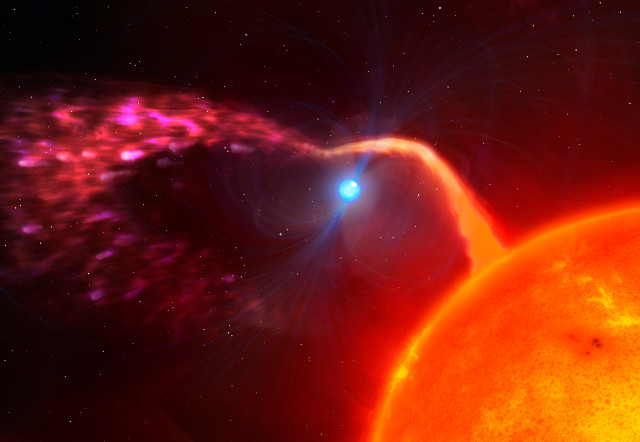
Artist concept of J0240+1952 and its companion (Image courtesy University of Warwick/Mark Garlick)

An article published in the journal “Monthly Notices of the Royal Astronomical Society: Letters” reports the discovery of the white dwarf with the fastest known rotation speed. A team of researchers used the HiPERCAM instrument mounted on the Gran Telescopio Canarias (GTC) to measure the rotation speed of the white dwarf cataloged as Lamost J024048.51+195226.9, or simply J0240+1952. Its rotation in 24.93 seconds makes it the fastest in its class. The examination also made it possible to establish that it’s a magnetic propeller system in which the white dwarf steals gas from a companion and then ejects it into space at very high speeds because of its intense magnetic field.

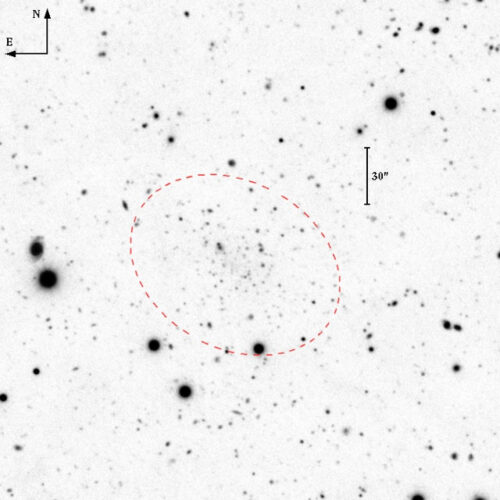
The dwarf galaxy Pisces VII seen by DOLoRes (Image courtesy W. Boschin/TNG)

An article published in the journal “Monthly Notices of the Royal Astronomical” reports the confirmation of the discovery of the dwarf galaxy Pisces VII, which could be a satellite of the Triangulum galaxy. A team of researchers led by David Martínez-Delgado of the Instituto de Astrofisica de Andalucia used the DOLoRes instrument at the Galileo National Telescope to confirm the existence of Pisces VII, originally identified by the amateur astronomer Giuseppe Donatiello. The gravitational bond with the Triangulum galaxy has yet to be verified but if the outcome were positive it would be a confirmation of the theories concerning galaxy formation, which predict the presence of various satellite galaxies. The reference is to the Lambda-CDM model, which also concerns dark matter.