Telescopes

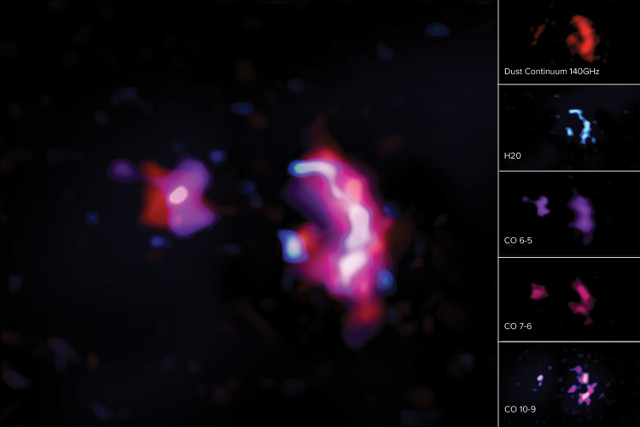
Water and carbon monoxide in the galaxy SPT0311-58 as seen by the ALMA radio telescope

Two articles, one published in “The Astrophysical Journal” and one in “Nature Astronomy”, report as many studies on molecules detected in the early universe thanks to the ALMA radio telescope. A team led by astronomer Sreevani Jarugula of the University of Illinois, USA, detected the presence of water in the galaxy SPT0311-58, about 12.88 billion light-years from Earth, the farthest ever detected in a galaxy without an active galactic nucleus. A team led by Maximilien Franco of the University of Hertfordshire, UK, detected the presence of hydrofluoric acid in the galaxy NGP–190387, about 12 billion light-years from Earth. In this case, the discovery is also important because the mechanisms of fluorine production are not very clear, and detecting their presence when the universe was about 1.4 billion years old indicates that the so-called Wolf-Rayet stars must be an important source of this element.

The galaxy protocluster G237

Two articles, one published in the journal “Astronomy & Astrophysics” and one in the journal “Monthly Notices of the Royal Astronomical Society”, report various aspects of the discovery of a galaxy protocluster in which there was an extraordinary rate of star formation when the universe was about 3 billion years old. A team of researchers led by Mari Polletta of the Italian National Institute of Astrophysics, Milan, found traces of the protocluster G237.01+42.50, or simply G237, in the data collected by the Planck Surveyor space probe and then used various telescopes to observe the galaxies inside it. The results were collected by a team led by Yusei Koyama of the National Astronomical Observatory, Japan.

M51 and an illustration of the system that could host an exoplanet

An article published in the journal “Nature Astronomy” reports the identification of a candidate exoplanet in another galaxy, cataloged as M51-ULS-1b. A team of researchers used NASA’s Chandra X-ray Observatory and ESA’s XMM-Newton Space Telescope to examine what could be the transit of a Saturn-sized exoplanet in M51, a pair of galaxies. In the larger of the two galaxies, there’s an ultra-luminous X-ray source consisting of a dead star and a blue supergiant, and the candidate exoplanet orbits them. The first confirmation of an extragalactic exoplanet would be extraordinary but in this case, not all alternative explanations can be completely ruled out.

The exoplanet 2M0437b near its star

An article published in the journal “Monthly Notices of the Royal Astronomical Society” reports the discovery of a newborn planet orbiting the red dwarf star 2M0437. A team coordinated by the University of Hawaii at Mānoa used various telescopes to confirm that the discovered object was a planet orbiting that star and to capture a direct image of it. 2M0437b is one of the youngest exoplanets discovered so far, born together with its star in the Taurus Cloud, a stellar nursery that has been the subject of various astronomical studies.

The galaxies NGC 4567 (top) and NGC 4568 (bottom) with supernova SN 2020fqv in the inset

An article to be published in the journal “Monthly Notices of the Royal Astronomical Society” reports observations of a supernova that was cataloged as SN 2020fqv in the galaxy NGC 4568. A team of researchers used the Hubble Space Telescope combining data collected with other instruments to study this supernova starting from the first moments of the explosion. Information on the last moments of the progenitor star’s life, on the materials very close to the supernova ejected from the star in the last year of its life, and on the first phase of the supernova will help find the signs of other upcoming supernovae.