Telescopes

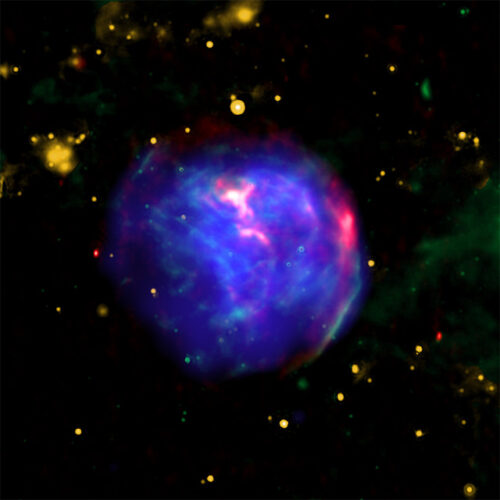
Composite image of G344.7-0.1 (X-ray: NASA/CXC/Tokyo Univ. of Science/K. Fukushima, et al.; IR: NASA/JPL/Spitzer; Radio: CSIRO/ATNF/ATCA)

An article published in “The Astrophysical Journal” reports a study on the supernova remnants cataloged as G344.7-0.1. A team of researchers combined observations in different bands of the electromagnetic spectrum to study the consequences of a Type Ia supernova, the explosion of a white dwarf that reached critical mass after stealing gas from a companion. These remnants can show in particular the effects of what is called reverse shock and offer new information to better understand these supernovae, important in the creation of elements such as iron that are scattered in interstellar space.

Infographic of water vapor's presence in Europa's atmosphere (Image ESA/Hubble, J. da Silva)

An article published in the journal “Geophysical Research Letters” reports the detection of a stable presence of water vapor in the atmosphere of Jupiter’s moon Europa. Lorenz Roth of the Kth Royal Institute of Technology in Stockholm, Sweden, used ultraviolet observations conducted with the Hubble Space Telescope between 1999 and 2015 to infer the presence of water vapor. Its presence appears to be persistent only in one hemisphere of Europa, the one opposite the moon’s direction of motion in its orbit.

Artist's concept of red dwarf magnetically interacting with a planet (Image courtesy Danielle Futselaar (artsource.nl))

Two articles – one published in the journal “Nature Astronomy” and one published in “The Astrophysical Journal Letters” – report different aspects of the discovery of radio wave emissions from 19 red dwarfs of which at least 4 could have originated from interaction with unknown planets. This study is based on detections obtained with the LOFAR radio telescope to examine the stellar magnetic activity of 19 red dwarfs. Radio emissions have also been detected from ancient and magnetically inactive stars. Data collected by NASA’s TESS space telescope was also added to get a more complete picture of that activity. The most likely explanation is that there’s an interaction with the magnetic field of planets that haven’t been detected.

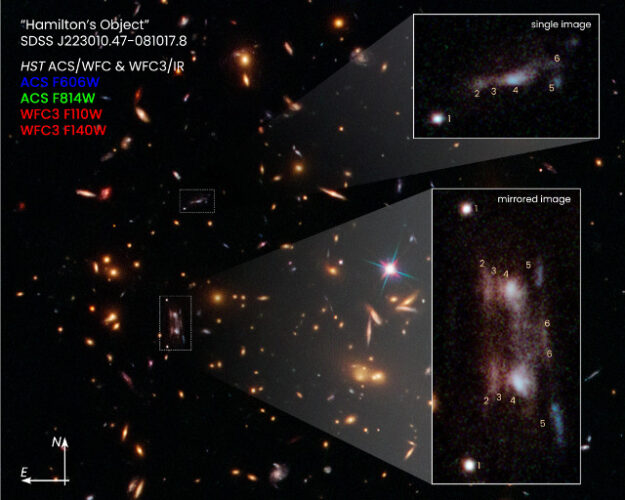
Hamilton's Object seen by Hubble

An article published in the journal “The Monthly Notices of the Royal Astronomical Society” reports a solution to an astronomical mystery involving two galaxies that appeared to be mirror images of each other and turned out to be two images of the same galaxy doubled by a gravitational lens. A team of researchers led by Richard Griffiths of the University of Hawaii at Hilo used observations made with the Hubble Space Telescope to obtain enough information to understand the nature of what was named Hamilton’s Object because it was discovered by astronomer Timothy Hamilton. Meanwhile, a third image of the galaxy was discovered, visible in another area of ​​the sky again thanks to the gravitational lens.

An article published in “The Astrophysical Journal Letters” reports a study on the exoplanet WASP-76b, an ultra-hot Jupiter where conditions could be even more hellish than previously thought. A team of researchers used the Gemini North telescope to study WASP-76b, the case that inaugurates a planetary atmosphere mapping project at Cornell University as part of ExoGemS (Exoplanets with Gemini Spectroscopy Survey). The discovery of abundant ionized calcium indicates that the temperature in the atmosphere is much higher than previous estimates or that there are very intense winds in the upper atmosphere.