Telescopes

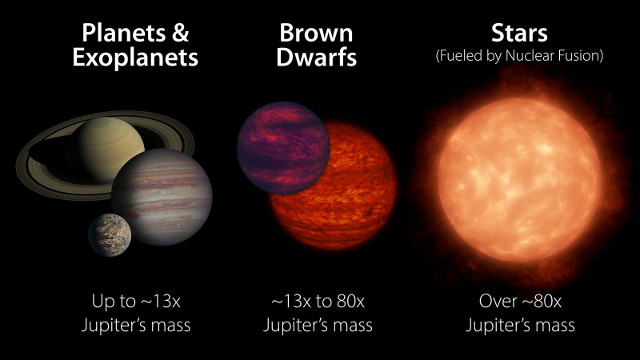
An infographic (NASA/JPL-Caltech) that offers a comparison of the sizes of planets, brown dwarfs, and very small stars

An article published in “The Astrophysical Journal Letters” reports a study on the brown dwarf classified as WISEA J153429.75-104303.3, or simply WISE 1534–1043, nicknamed the Accident because it was discovered purely by chance. A team of researchers used observations conducted with various telescopes to try to understand the characteristics of a brown dwarf different from the ones already known. Its emissions are very dim making it difficult to obtain the desired information but the researchers’ conclusion is that it’s very old, with an age between 10 and 13 billion years, and passed close to much more massive objects that accelerated it until reaching the remarkable speed detected. Its relative proximity to Earth could be random or indicate that brown dwarfs of that type are more common than expected but we can’t detect them with current instruments.

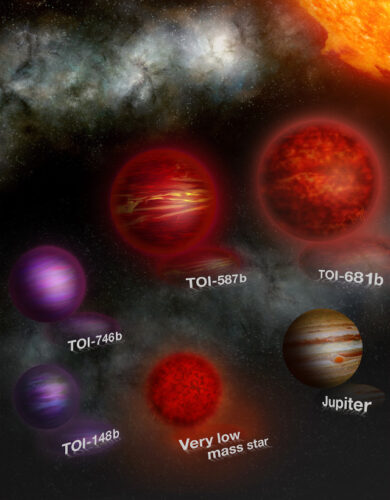
An artistic illustration of these objects together with Jupiter as a size comparison

An article published in the journal “Astronomy & Astrophysics” reports a study on 5 objects on the boundary between brown dwarf and star discovered thanks to NASA’s TESS space telescope. A team of researchers coordinated by a group of Swiss entities conducted follow-up observations of the 5 objects to better understand the nature of brown dwarfs, what distinguishes them from stars, and what is the boundary between these two classes of objects.

Asteroid 2021 PH27 seen in two different moments

The announcement came of the discovery of asteroid 2021 PH27, which has the shortest orbital period among the known asteroids with about 113 Earth days. Astronomer Scott S. Sheppard of the Carnegie Institution of Science identified it in data collected by the Dark Energy Camera (DECam), an instrument designed for cosmological research that on several occasions has also proved useful for other astronomical research. In this case, the images were captured by Ian Dell’Antonio and Shenming Fu of Brown University on August 13, 2021. The orbit of 2021 PH27 is probably not stable over the long period, and studying this asteroid will help to understand the movements of objects with orbits close to that of the planet Mercury.

Fragments of comet C/2019 Y4 (ATLAS) seen by Hubble

An article published in the “Astronomical Journal” reports the results of a study on comet C/2019 Y4 (ATLAS) whose conclusion is that it’s a fragment of a larger comet whose passage could have been seen on Earth about 5,000 years ago. A team of researchers led by astronomer Quanzhi Ye of the University of Maryland in College Park used observations conducted with the Hubble Space Telescope to examine this comet and its orbit. In fact, there are now various fragments and it’s possible that the progenitor gave rise to an entire family of comets. Amateur astronomer Maik Meyer identified a correlation with C/1844 Y1, nicknamed the Great Comet of 1844.

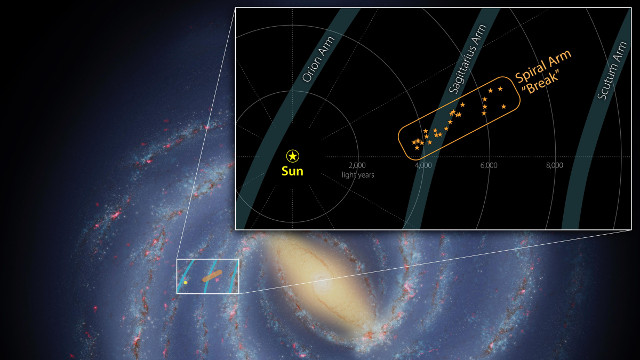
A reconstruction of the Milky Way, the Sagittarius Arm and its "splinter"

An article published in the journal “Astronomy & Astrophysics” reports the discovery of an anomalous structure in the Milky Way’s Sagittarius Arm. A team of researchers used observations made with NASA’s Spitzer Space Telescope and data collected by ESA’s Gaia space probe to locate a structure about 3,000 light-years long that has an orientation that’s very different from the rest of the Sagittarius Arm. Such structures have been identified in other galaxies but it’s the first time that one of them has been identified within the Milky Way. That’s not a surprise, as it’s difficult to study such large structures of the galaxy from the inside.