Telescopes

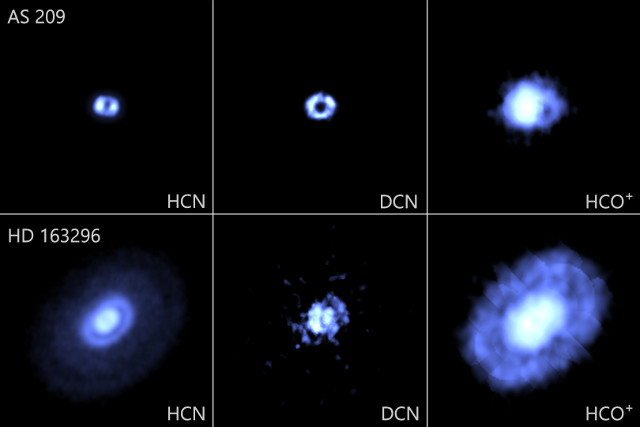
Molecules mapped in the protoplanetary disks around the stars AS 209 and HD 163296

A series of articles published in the “Astrophysical Journal Supplement Series” reports the detection of organic molecules potentially important for the birth of life forms in some protoplanetary disks. A team of researchers used the ALMA radio telescope as part of the MAPS program. ALMA made it possible to detect the emissions of molecules such as cyanoacetylene, acetonitrile, and cyclopropenylidene in the disks of young stars IM Lupi, GM Aurigae, AS 209, HD 163296, and MWC 480. These organic compounds are precursors of more complex molecules important in biological processes and some of them are similar to those that formed in the solar system.

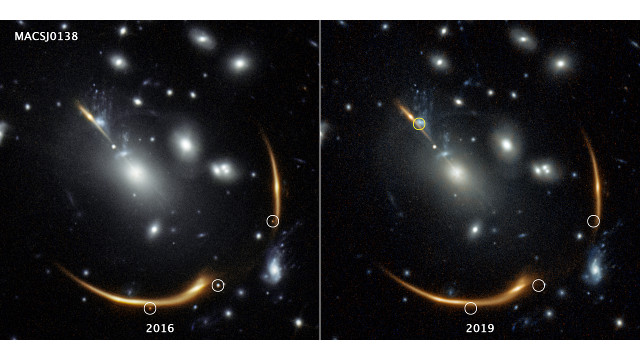
The galaxy cluster MACS J0138.0-2155 and the Requiem supernova

An article published in the journal “Nature Astronomy” reports a study on a supernova whose glow was distorted and multiplied by a gravitational lens. A team of researchers examined various images captured over the years by the Hubble Space Telescope after three images of the supernova AT 2016jka, dubbed Requiem, were discovered in 2016 archival data. As it’s normal, its brightness faded away until it disappeared but, according to the researchers, a fourth image of that supernova will be visible in 2037, again due to the distortion generated by the gravitational lens produced by the force of gravity of the galaxy cluster MACS J0138.0-2155, or simply MACS J0138.

A representation of the solar system up to the Kuiper Belt

An article published in “The Planetary Science Journal” reports a study on some Kuiper Belt Objects (KBOs) that are part of a particular group of which new observations revealed a blue color and a binary nature. A team of researchers used observations ran by the Col-OSSOS team which obtained color measurements of 98 Kuiper Belt Objects while also offering new insights into the subgroup of objects called cold classical Kuiper Belt Objects. Their conclusion is that the blue binary objects were pushed into that area by Neptune as it moved away from the Sun.

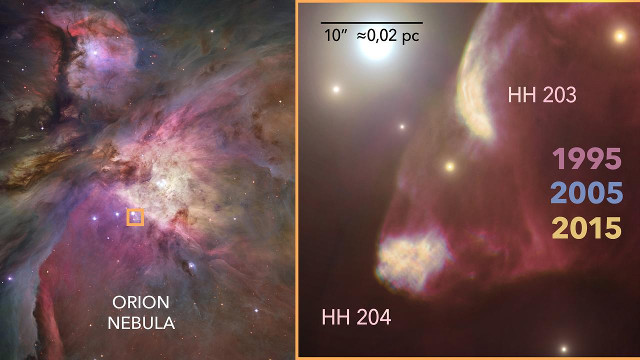
The Orion Nebula seen by the Hubble Space Telescope and on the right the zoom of HH204 with its jet of materials

An article published in “The Astrophysical Journal” reports a study that reveals in detail never before seen the physical and chemical effects of the impact of a protostellar jet in the Orion Nebula. A team of researchers led by José Eduardo Méndez Delgado, a doctoral student at the Instituto de Astrofísica de Canarias (IAC), used observations conducted with the VLT and twenty years of images from the Hubble Space Telescope. This made it possible to examine the impact of the protostellar jet emitted by the object cataloged as HH204 on the surrounding environment and the consequent changes in the density and temperature of the gas in the Orion Nebula. This in turn caused an increase in the gas level of atoms of heavy elements such as iron and nickel.

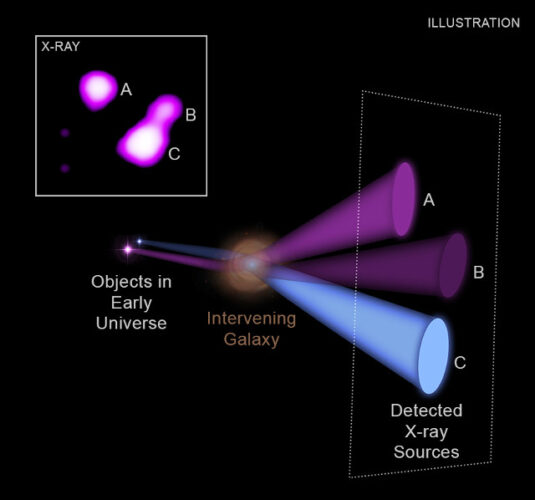
Illustration of MG B2016+112

An article published in “The Astrophysical Journal” reports a study on a double X-ray source in the early universe cataloged as MG B2016+112 which could be composed of two supermassive black holes whose image is distorted by a gravitational lens. Cristiana Spingola, Daniel Schwartz, and Anna Barnacka started from a survey obtained by NASA’s Chandra X-ray Observatory to examine the double object observed. This is an unprecedented situation because from the Earth we see it as it was when the universe was about two billion years old with the two components separated by only 650 light-years. At present, it cannot be ruled out that it’s a single supermassive black hole and one of its jets of materials whose image was strongly distorted by the gravitational lens.