Telescopes

The free-floating planet CFBDSIR 2149-0403 (Image ESO/P. Delorme)

An article published in the journal “Monthly Notices of the Royal Astronomical Society” reports the identification of candidate gravitational microlens events that could be the traces of free-floating planets, which are planets that do not orbit any star. A team of researchers led by Iain McDonald used data obtained in 2016 during NASA’s Kepler Space Telescope K2 mission while monitoring a star-filled area near the center of the Milky Way. The result is the discovery of 27 signals generated by possible gravitational microlenses which lasted between one hour and 10 days. The four shortest events are consistent with Earth-sized planets.

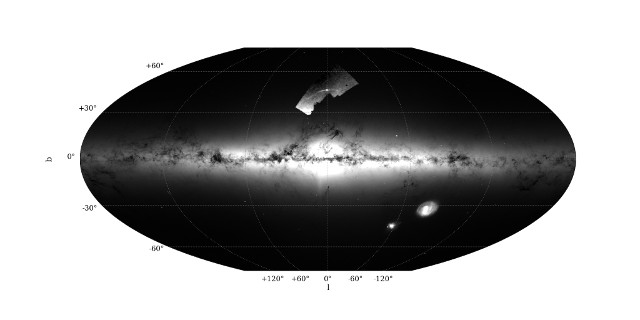
A view of the sky with Palomar 5 at the top-center

An article published in the journal “Nature Astronomy” reports a study on the star cluster Palomar 5 that indicates that in a billion years only black holes will remain inside it. A team of researchers led by Professor Mark Gieles of the University of Barcelona studied this ancient and very low-density cluster by conducting a series of simulations to try to predict its future. The number of black holes inside it is already above average today and is subject to gravitational interactions with the consequence that in the distant future its size will increase and only black holes will remain.

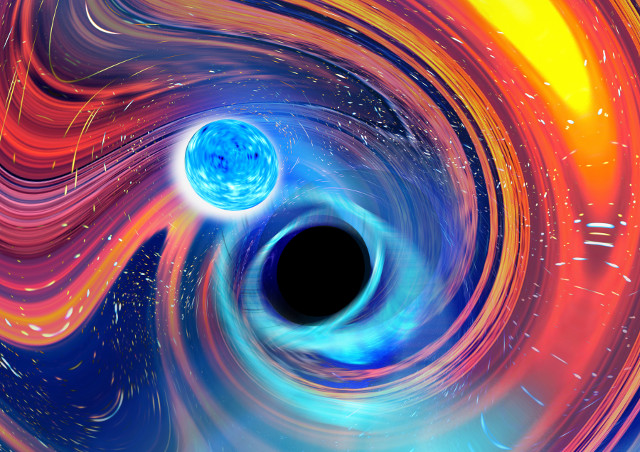
Artist's concept of merger between a black hole and a neutron star. (Image courtesy Carl Knox, OzGrav - Swinburne University)

An article published in “The Astrophysical Journal Letters” reports the detection of gravitational waves emitted by two cases of mergers of a black hole with a neutron star. Scientists from the LIGO, Virgo, and KAGRA collaborations examined data collected by the Advanced LIGO and Advanced Virgo detectors to find evidence of this type of merger in two events detected in January 2020. Previously, there were other candidates but the data left various doubts about the nature of the objects that merged.

The supernova 2018zd, in the white circle on the right, near the galaxy NGC 2146

An article published in the journal “Nature Astronomy” reports a study on the supernova 2018zd. A team of researchers studied observations conducted with various telescopes and concluded that this supernova is of the electron-capture type, which was theorized 40 years ago but never identified with certainty. According to the researchers, 2018zd matches the theoretical predictions and offers new confirmations to the hypothesis that the supernova observed in A.D. 1054 was of the electron-capture type.

RCW 49 (Image NASA/JPL-Caltec/E.Churchwell (University of Wisconsin))

An article published in “The Astrophysical Journal” reports a study concerning a stellar nursery inside the RCW 49 nebula. A team of researchers coordinated by the University of Maryland used data obtained with the SOFIA flying telescope and combined them with others obtained with other instruments to obtain a 3D reconstruction of a gigantic structure of ionized hot plasma that is expanding around the open star cluster Westerlund 2. The main “suspect” behind that expansion is the star WR 20a.