Telescopes

The galaxy NGC1052-DF2 (Image NASA, ESA, Z. Shen and P. van Dokkum (Yale University), and S. Danieli (Institute for Advanced Study))

An article published in “The Astrophysical Journal Letters” reports a precise measurement of the distance of the galaxy NGC1052-DF2 that was used to confirm that it’s almost devoid of dark matter, a notable anomaly. A team of researchers led by Pieter van Dokkum of Yale University used the Hubble Space Telescope to observe the red giants on the outskirts of NGC1052-DF2 using them as “standard candles” taking advantage of the fact that they all reach the same peak in brightness. Understanding why so few of the gravitational effects attributed to dark matter are detected in this galaxy may offer new clues to its nature.

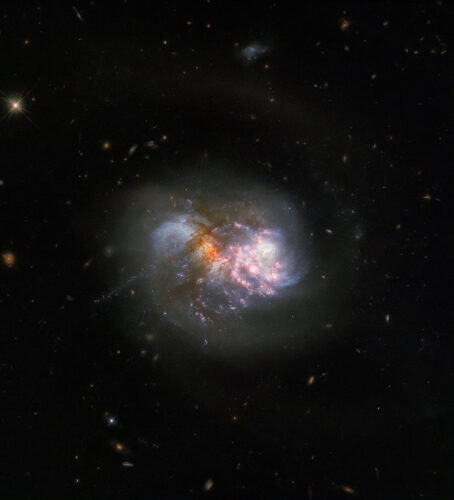
The IC 1623 pair seen by Hubble (Image ESA/Hubble & NASA, R. Chandar)

A new image captured by the Hubble Space Telescope shows a pair of galaxies in an advanced phase of merger cataloged as IC 1623. The filters used for the Wide Field Camera 3 (WFC3) instrument that captured the image allow seeing the differences between the two galaxies that are merging. This process can still continue for millions of years, so it will take who knows how long before a new galaxy is formed. Meanwhile, astronomers expect gas pushed by gravitational interactions to trigger a new star formation in what will subsequently be referred to as a starburst galaxy.

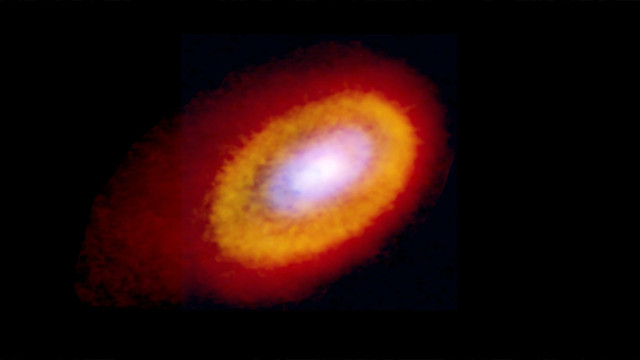
The Elias 2-27 system seen by ALMA

Two articles, one published in “The Astrophysical Journal” and one in “The Astrophysical Journal Letters”, report various aspects of a study of the protoplanetary disk surrounding the young star Elias 2-27. Two teams of researchers with various members in common and Teresa Paneque Carreño as principal investigator used the ALMA radio telescope to study that star system in formation. In particular, they studied the gravitational perturbations that generated the spiral arms in the disk. This is a step forward in understanding the mechanisms of formation of new planets.

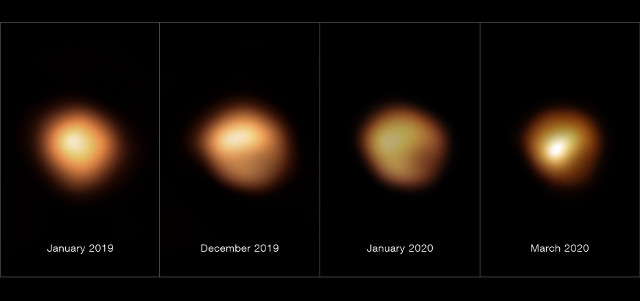
Betelgeuse seen by SPHERE

An article published in the journal “Nature” reports a study on the dimming of the star Betelgeuse that happened between the end of 2019 and the first quarter of 2020 that suggested that its explosion in a supernova was imminent. A team of researchers led by Miguel Montargès of the Katholieke Universiteit Leuven in Belgium used ESO’s VLT to obtain images of Betelgeuse in December 2019 to compare with one from January 2019 and other subsequent images. The results confirm those of a previous study concluding that a gigantic mass of very hot plasma has risen from the surface of Betelgeuse. The plasma moved away, cooling and turning into dust that covered the star’s surface, reducing its brightness to a third of normal.

The quasar J1243+0100 (Image ALMA (ESO/NAOJ/NRAO), Izumi et al.)

An article published in “The Astrophysical Journal” reports the discovery of high-speed gas flows pushed by the supermassive black hole at the center of a galaxy over 13 billion light-years from Earth. A team of researchers led by Takuma Izumi of the National Astronomical Observatory of Japan (NAOJ) used the ALMA radio telescope to observe the galaxy HSC J124353.93+010038.5, or simply J1243+0100. It’s the oldest known galaxy so far with a wind of that size. This shows how supermassive black holes can heavily influence the galaxies that host them and that this has been happening since the universe was very young.