Artist's concept of RS Ophiuchi showing the white dwarf stealing gas from its companion (Image courtesy DESY/H.E.S.S., Science Communication Lab)

An article published in the journal “Nature Astronomy” reports a study of the recurrent nova known as RS Ophiuchi based on the detection of the gamma rays emitted by the last outburst that occurred on the white dwarf part of the pair. MAGIC Collaboration researchers examined data collected by the MAGIC telescopes and concluded that outbursts of that type generate some of the gamma rays present in the Milky Way.

Comet C/2014 UN271 (Bernardinelli-Bernstein)

An article published in “The Astrophysical Journal Letters” reports a study on comet C/2014 UN271 (Bernardinelli-Bernstein) conducted thanks to observations made with the Hubble Space Telescope. A team of researchers also used previous observations to estimate that this comet’s nucleus is about 119 kilometers in diameter. This result confirms that it’s the largest known comet. The studies will continue even if it will remain very far from Earth also because it almost certainly comes from the Oort cloud.

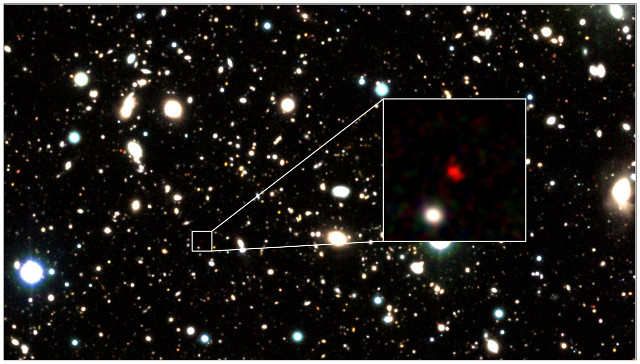
HD1 in the zoom-in image (Image courtesy Harikane et al.)

An article published in “The Astrophysical Journal” reports the discovery of what could set the new record for the most distant known galaxy. A team of researchers used various telescopes to observe this object, cataloged as HD1, whose distance has been estimated to be about 13.5 billion light-years from Earth.

In another article, published in the journal “Monthly Notices of the Royal Astronomical Society Letters”, some of the researchers offer some theories about HD1. It could be a so-called starburst galaxy with an extraordinary star formation star which could include the first generation of stars in the universe or a quasar powered by the oldest known supermassive black hole.

The Crew Dragon Endeavour spacecraft docking with the International Space Station in its Ax-1 mission (Image NASA TV)

A little while ago, SpaceX’s Crew Dragon Endeavour spacecraft docked with the International Space Station’s Harmony module completing the first part of its private Axiom Mission 1 or simply Ax-1 mission that began with its launch yesterday. After they verify that the pressure has been correctly balanced, the hatch will be opened to allow Michael López-Alegría, Larry Connor, Eytan Stibbe, and Mark Pathy to enter the Station.

SpaceX Crew Dragon Endeavor starting its Ax-1 mission blasting off atop a Falcon 9 rocket (Image NASA TV)

A little while ago, the SpaceX Crew Dragon Endeavor spacecraft blasted off atop a Falcon 9 rocket from the Kennedy Space Center in the Axiom Mission 1 or simply Ax-1 mission. After about twelve minutes it successfully separated from the rocket’s last stage. It will spend approximately 10 days in orbit which includes 8 days on the International Space Station. Unlike the private space missions conducted last year, the Ax-1 also has commercial purposes in a collaboration between SpaceX, Axiom Space, and NASA to access the Station for the purpose of conducting work useful for the development of new technologies and scientific research.