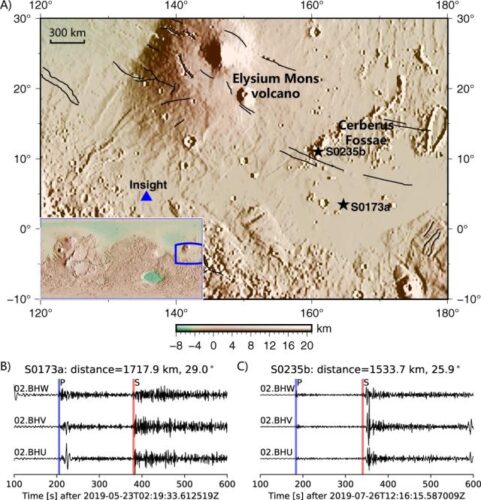
Map of the major marsquakes detected by the InSight lander

An article published in the journal “Nature Communications” reports a study that offers evidence that the marsquakes detected by NASA’s InSight lander are caused by the activity of underground volcanic magma. Doctor Weijia Sun of the Chinese Academy of Sciences and Professor Hrvoje Tkalčić of the Australian National University examined data collected by InSight identifying 47 underground marsquakes in the Cerberus Fossae region of Mars over the course of 350 Martian days. According to the two researchers, the Martian mantle is still active and the marsquakes are of volcanic origin and not tectonic, as the scientists who studied Mars believed.

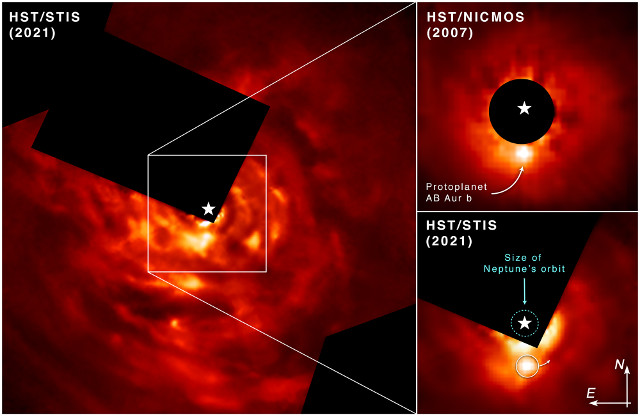
The AB Aurigae system and its protoplanet seen by Hubble

An article published in the journal “Nature Astronomy” reports a study on the protoplanet cataloged as AB Aurigae b, a gas giant that is growing following an unusual process called disk instability. A team of researchers used observations made with the Hubble Space Telescope and the Subaru Telescope on Mauna Kea, Hawaii, between 2007 and 2021 to find evidence of that violent formation. Proving that gas giants can form as a result of disk instability will help better understand the history of the solar system as well.

A portion of Pluto's surface in grayscale with an artistic interpretation of how cryovolcanic processes may have operated indicated in blue

An article published in the journal “Nature Communications” reports a study on the activity of cryovolcanoes existing on the dwarf planet Pluto which highlights how it has continued until recent times from a geological point of view and may still be present. A team of researchers led by Kelsi Singer of the Southwest Research Institute used data collected by NASA’s New Horizons space probe to examine the marks left by cryovolcanoes in the Sputnik Planitia region, in the large heart-shaped area on the surface. One conclusion is that Pluto has an underground heat source that kept it geologically active much longer than might be expected from a dwarf planet.

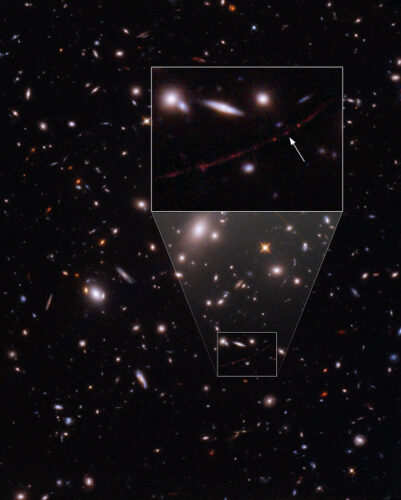
Earendel, indicated by an arrow, seen by Hubble (Image NASA, ESA, B. Welch (JHU), D. Coe (STScI), A. Pagan (STScI) )

An article published in the journal “Nature” reports the discovery of the most distant single star, nicknamed Earendel. A team of researchers used data collected during the RELICS (Reionization Lensing Cluster Survey) program using the Hubble Space Telescope to search for the brightest galaxies dating back to the first billion years of the universe’s life. A large galaxy cluster cataloged as WHL0137-08 distorted the image of very distant galaxies in a gravitational lensing effect to the point that it can detect a single star about 12.9 billion light-years away from Earth. Earendel’s study, whose mass was estimated to be at least 50 times the Sun’s, will help to better understand the formation and evolution of the very first generations of stars in the universe.

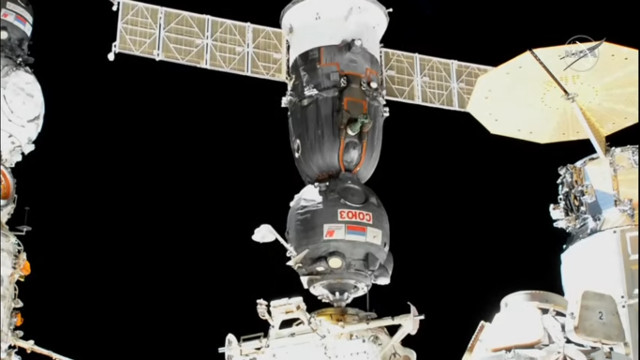
The Soyuz MS-19 spacecraft leaves the International Space Station (Image NASA TV)

A little while ago, cosmonauts Anton Shkaplerov and Pyotr Dubrov and astronaut Mark Vande Hei returned to Earth on the Soyuz MS-19 spacecraft, which landed in Kazakhstan. Shkaplerov spent nearly 6 months on the International Space Station, where he arrived on October 5, 2021, as part of Expedition 65. Dubrov and Vande Hei arrived on April 9, 2021, as part of Expedition 64 and completed a long-duration mission.