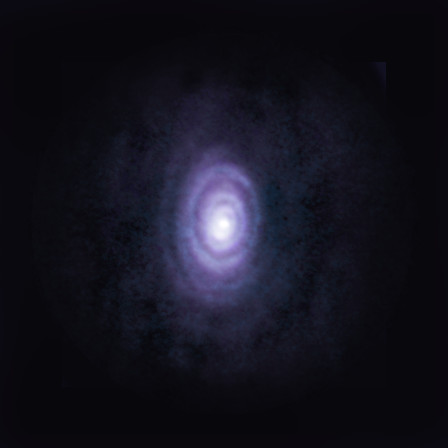
The star V Hydrae and its rings seen by ALMA (Image ALMA (ESO/NAOJ/NRAO)/S. Dagnello (NRAO/AUI/NSF))

An article accepted for publication in “The Astrophysical Journal” reports the results of a study of the star V Hydrae that includes the discovery of a system of six rings that surround it and are expanding and two hourglass structures. A team led by Raghvendra Sahai of NASA’s JPL used the ALMA radio telescope and data collected with the Hubble Space Telescope to study the materials that were ejected by V Hydrae in the agony that will lead to its death. These observations can provide valuable information to better understand the processes taking place during a relatively short phase that for this reason is difficult to observe.

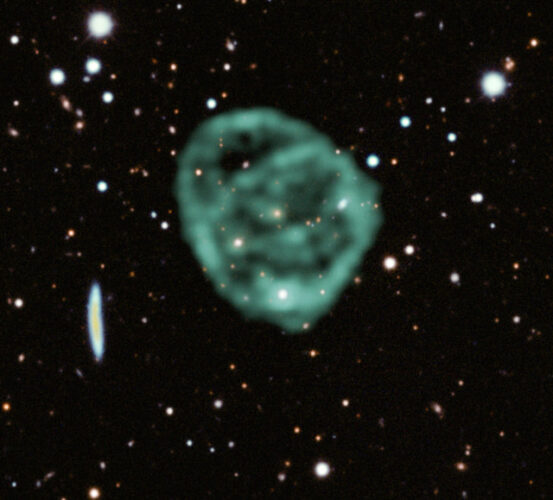
ORC1 seen by MeerKAT and in the background optical data from the Dark Energy Survey (Image J. English (U. Manitoba)/EMU/MeerKAT/DES(CTIO))

An article published in the journal “Monthly Notices of the Royal Astronomical Society” reports a study based on a new image of a so-called odd radio circle (ORC). A team of researchers used the MeerKAT radio telescope to observe this structure with a diameter of over one million light-years visible only at radio waves. Each new observation of this type of phenomenon offers new information, as only five of them are known at the moment. The information collected with MeerKAT could help verify the theories that were proposed and reach a reasonably certain explanation for its origin and nature.

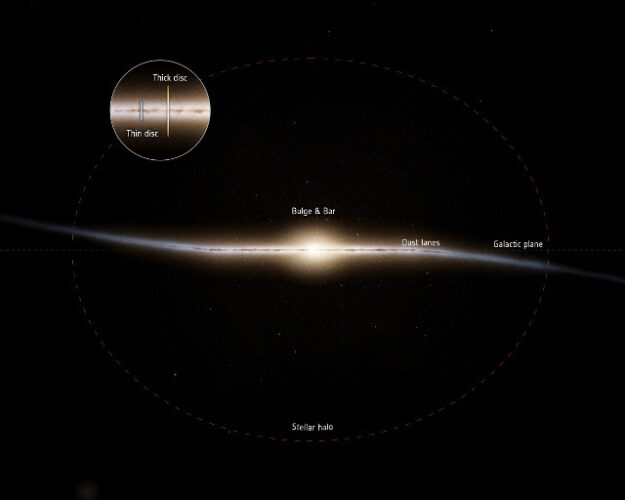
Milky Way edge-on view

An article published in the journal “Nature” reports a study on the Milky Way’s formation that provides evidence that the part known as the thick disc started forming about 13 billion years ago, 2 billion earlier than previously thought. Maosheng Xiang and Hans-Walter Rix of the Max-Planck Institute for Astronomy, Heidelberg, Germany, used data collected by ESA’s Gaia space probe and observations conducted with the LAMOST telescope to reconstruct the Milky Way’s formation and evolution phases. In particular, the researchers focused on the period between 13 and 8 billion years ago, when there were galactic mergers and a lot of hydrogen was consumed in a phase of remarkable star formation.

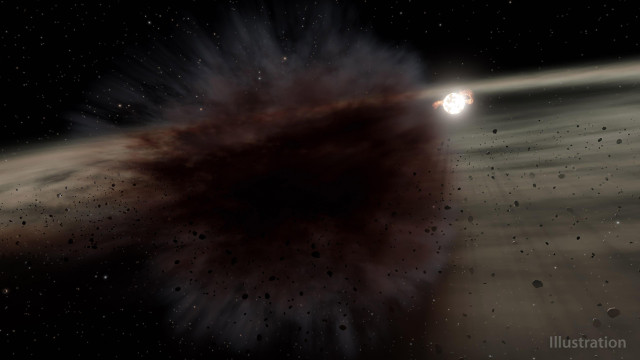
Artist's concept of a cloud of debris in the system of the star HD 166191 (Image NASA/JPL-Caltech)

An article published in “The Astrophysical Journal” reports a study on the star system cataloged as HD 166191, which has an estimated age of 10 million years and is still in its formation process with objects that form but also get destroyed following collisions. A team of researchers led by Kate Su of the University of Arizona used data collected between 2015 and 2019 using NASA’s Spitzer Space Telescope and ground-based telescopes to detect traces of debris clouds generated by collisions between planetesimals. The information obtained from these data is very useful to improve our knowledge of the formation and evolution of planetary systems.

The Soyuz MS-21 spacecraft (at the center) docked with the International Space Station (Image NASA TV)

A few hours ago, the Soyuz MS-21 spacecraft was launched from the Baikonur Cosmodrome in Kazakhstan and after a little more than three hours reached the International Space Station with three new crew members on board. It docked with the Station’s Prichal module. As is becoming increasingly common for crewed trips as well, the ultra-fast track was used which halves the journey duration.