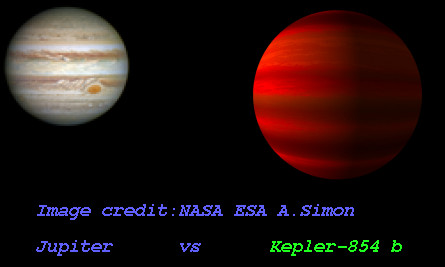
Artist's concept of Kepler-854b as en exoplanet compared to Jupiter

An article published in “The Astronomical Journal” reports a study that reviews the data of four objects discovered a few years ago thanks to NASA’s Kepler space telescope, concluding that at least three of them are actually tiny stars and not planets. A team of researchers used new data collected by ESA’s Gaia space probe to get more precise information on objects cataloged as exoplanets. Kepler-854b, Kepler-840b, and Kepler-699b appear to have sizes between two and four times Jupiter’s, too much even for hot Jupiters very close to their stars but possible for tiny stars. Kepler-747b turns out to have a radius 1.8 times Jupiter’s even though it’s quite far from a star a little smaller than the Sun, so its nature is uncertain.

The pulsar j2030 and part if its filament seen at X-rays and optical frequencies

An article accepted for publication in “The Astrophysical Journal” reports a study on the long filament generated by the pulsar cataloged as PSR J2030+4415, or simply J2030. Martjin de Vries and Roger Romani of the American Stanford University used observations made using NASA’s Chandra X-ray Observatory and ground-based telescopes to study a filament that has an estimated length of about 7 light-years and is composed of matter but also of antimatter. Pulsar emissions of this type could explain positron detections in the Milky Way.

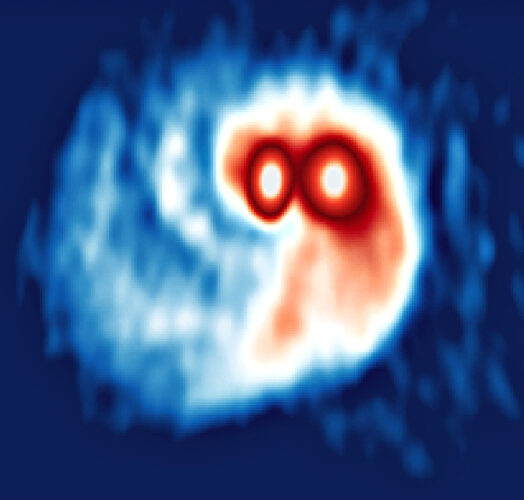
The SVS 13 system seen by ALMA

An article accepted for publication in “The Astrophysical Journal” reports a study on the binary system cataloged as SVS 13, consisting of two protostars surrounded by disks of materials that could lead to the formation of planets. A team of researchers used thirty years of observations conducted with the VLA and new observations conducted with the ALMA radio telescope to obtain a detailed picture of the situation. The conclusion is that each of the two protostars has its own circumstellar disk and that there’s a third disk of the circumbinary type that orbits both stars. The analysis of the data also led to the identification of nearly thirty molecules in the SVS 13 system including thirteen complex organic molecules precursors of life.

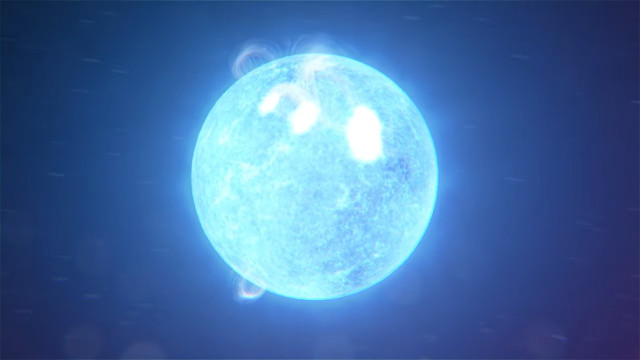
Artist's representation of the magnetar SGR 1830 and its spots (Image NASA's Goddard Space Flight Center)

An article published in “The Astrophysical Journal Letters” reports a study on the magnetar cataloged as SGR 1830-0645, or simply SGR 1830, and spots on its surface that generated X-ray emissions. A team of researchers used the NICER telescope installed on the International Space Station to monitor the outbursts on the surface of SGR 1830 and the merger of three spots into one. More data was collected thanks to NASA’s Swift Space Telescope. The conclusion is that this is an activity that has similarities with the movements of tectonic plates on Earth. The magnetic field of the magnetar can cause its surface to deform, crack, and even melt even though it’s extremely hard. Spots are areas where Sun-like coronal loops connect to the surface.

Some of the images captured by the ACS instrument (Image NASA, ESA)

NASA and ESA celebrated the 20th anniversary of the installation of the Hubble Space Telescope’s ACS (Advanced Camera for Surveys) instrument with the publication of some images among the more than 125,000 captured during these twenty years of service. On March 7, 2002, astronauts James Newman and Mike Massimino installed the ACS during the space shuttle Columbia’s STS-109 mission. This instrument made a significant contribution to a lot of extraordinary astronomical research conducted using Hubble.