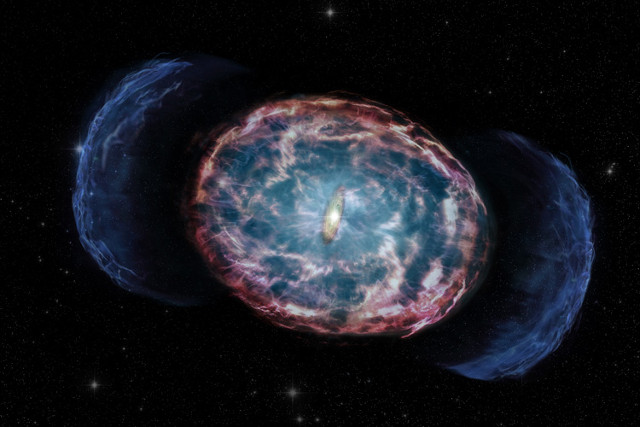
Artist's representation of the evolution of the GW170817 kilonova

An article accepted for publication in “The Astrophysical Journal Letter” reports a study based on the X-ray emissions from the kilonova generated by the merger of two neutron stars in the event detected by gravitational waves on August 17, 2017, and cataloged as GW170817. A team of researchers used observations conducted with NASA’s Chandra X-ray Observatory in the years following the first detection to monitor the evolution of the kilonova’s remnants. So far, this is the only kilonova identified with certainty and it was detected at both electromagnetic and gravitational waves but there’s still no certainty of what was produced by the GW170817 event. The X-ray emissions could indicate that a black hole was born but they could be emissions that are a kind of afterglow of the kilonova.

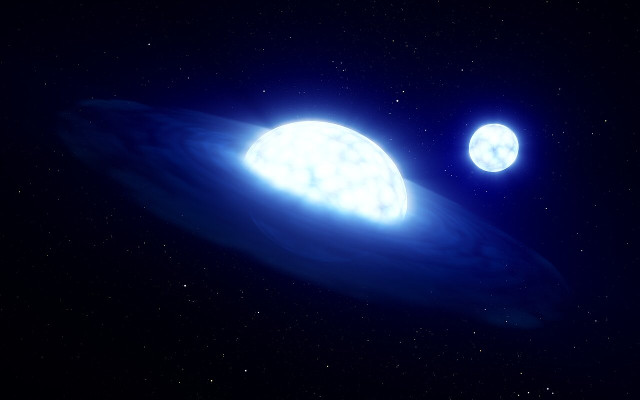
The HR 6819 system in the new interpretation of the data (Image ESO/L. Calçada)

An article published in the journal “Astronomy & Astrophysics” reports a new study on the HR 6819 system that offers a more convincing explanation than the one proposed in 2020, when the presence of a black hole was proposed as part of a triple system. A team of researchers led by Abigail Frost of Ku Leuven, Belgium, which includes members of the team that claimed the black hole’s presence and members of the team that already offered an alternative explanation, used new observations obtained with ESO’s VLT that include the use of the VLTI interferometer to try to get a final answer. The conclusion is that HR 6819 is a binary system in which there is no black hole but there is a phenomenon of stellar vampirism in which one of the two stars has torn large quantities of hydrogen from its companion.

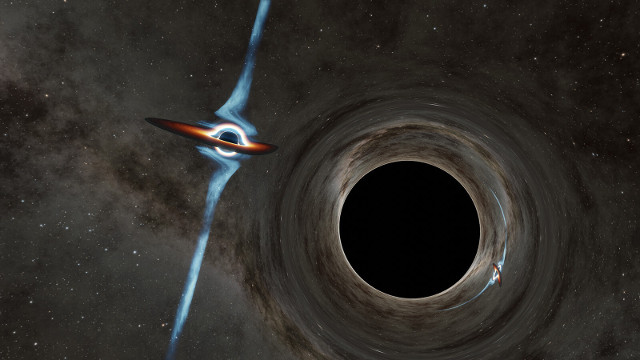
Artist's concept of the blazar PKS 2131-021 with its pair of supermassive black holes (Image courtesy Caltech/R. Hurt (IPAC))

An article published in “The Astrophysical Journal Letters” reports a study on the blazar cataloged as PKS 2131-021 that offers evidence that it contains a pair of supermassive black holes orbiting each other in a period of two years. A team of researchers used data collected from different telescopes with radio observations going back in time to 1975 to reconstruct what happens inside PKS 2131-021 by exploiting its nature as a blazar. That’s because, by definition, a blazar is powered by a supermassive black hole that emits a jet of materials at very high speeds oriented towards the Earth. The examination of the jet from PKS 2131-021 showed movement caused by the orbital movements of the black hole and a companion around each other. According to the researchers, from the Earth’s point of view, these two supermassive black holes will merge in about 10,000 years.

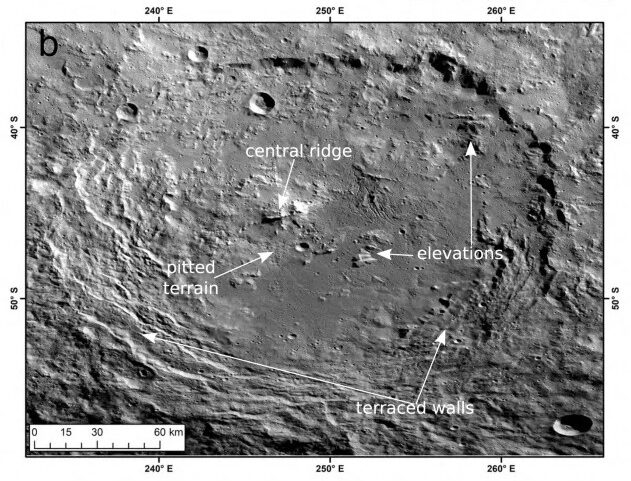
Urvara crater on the dwarf planet Ceres

An article published in the journal “Nature Communications” reports the identification of salts and organic compounds in Urvara crater on the dwarf planet Ceres. A team of researchers used data collected by NASA’s Dawn space probe to conduct the most detailed investigation of Urvara Crater, the third-largest impact crater on Ceres. The results are not surprising and indeed confirm the discoveries of recent years concerning above all the two largest craters, Occator and Ernutet. The famous bright spots that were named faculae in jargon, mysterious before close examinations, shine thanks to the salts they contain, and now the confirmation also arrived for Urvara. This result also confirms the presence at least in the past of an underground ocean in which very salty water remained in a liquid state and perhaps there’s still some.

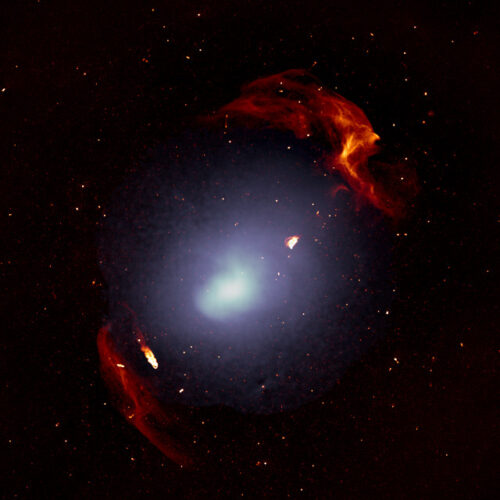
The galaxy cluster Abell 3667

An article published in the journal “Astronomy & Astrophysics” reports the most detailed view ever obtained of remains inside the galaxy cluster Abell 3667 with a shock wave that expands over about 6.5 million light-years, the largest ever identified. A team of researchers led by Francesco de Gasperin of the Italian National Institute of Astrophysics used the MeerKAT radio telescope to obtain detailed images of a shock wave generated by the collision between two galaxy clusters that occurred over a billion years ago.