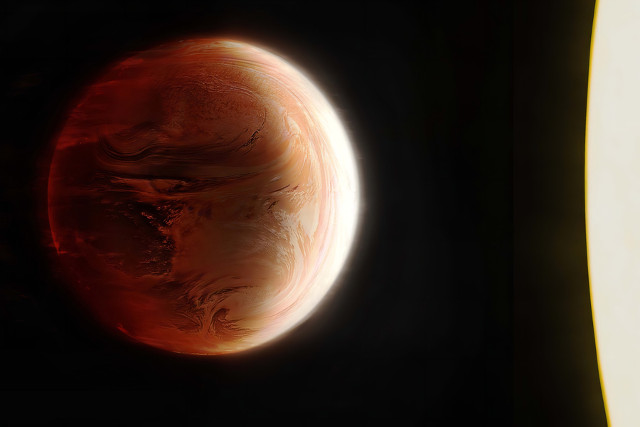
Artist's concept of the exoplanet WASP-121b (Image Engine House VFX)

An article published in the journal “Nature Astronomy” reports the results of a new study on the exoplanet WASP-121b, an ultrahot Jupiter considered one of the planets with the most extreme conditions known. A team of researchers led by Tom Evans, today at the Max Planck Institute for Astronomy in Heidelberg, Germany, used data collected by the Hubble Space Telescope to investigate compounds present in WASP-121b’s atmosphere. The conclusion is that there may be clouds of iron, titanium, and corundum, the crystallized form of aluminum oxide that makes up rubies and sapphires.

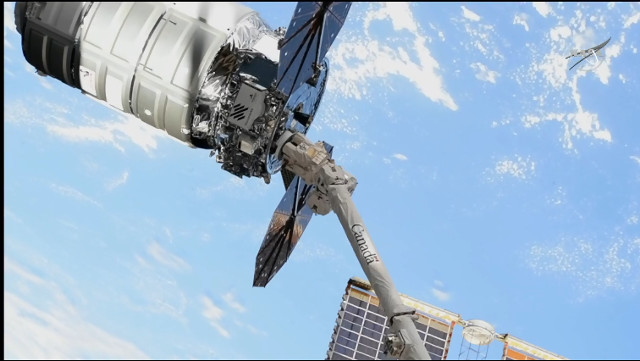
The Cygnus S.S. Piers Sellers cargo spacecraft captured by the Canadarm2 robotic arm (Image NASA TV)

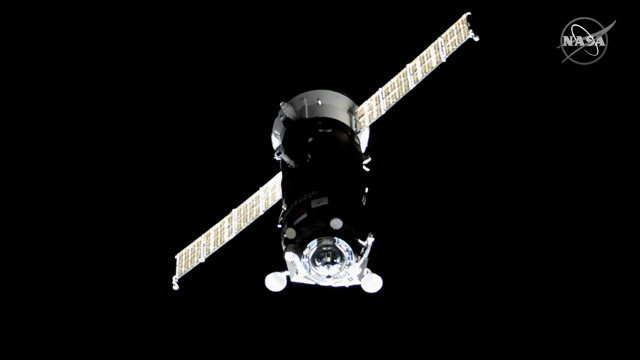
Northrop Grumman’s Cygnus spacecraft, launched last Saturday, February 19, has just reached the International Space Station and was captured by the Canadarm2 robotic arm. Astronaut Raja Chari, assisted by his colleague Kayla Barron, will soon begin the slow maneuver to move the Cygnus until it docks with the Station’s Unity module after about two hours.

The Cygnus S.S. Piers Sellers cargo spacecraft blasting off atop an Antares rocket (Image NASA TV)

A little while ago, Northrop Grumman’s Cygnus spacecraft blasted off atop an Antares rocket from the Mid-Atlantic Regional Spaceport (MARS), part of NASA’s Wallops Flight Facility (WFF) on Wallops Island. After about nine minutes it successfully separated from the rocket’s last stage went en route to its destination. This is its 17th official mission, called NG-17 or CRS NG-17, to transport supplies to the International Space Station for NASA.

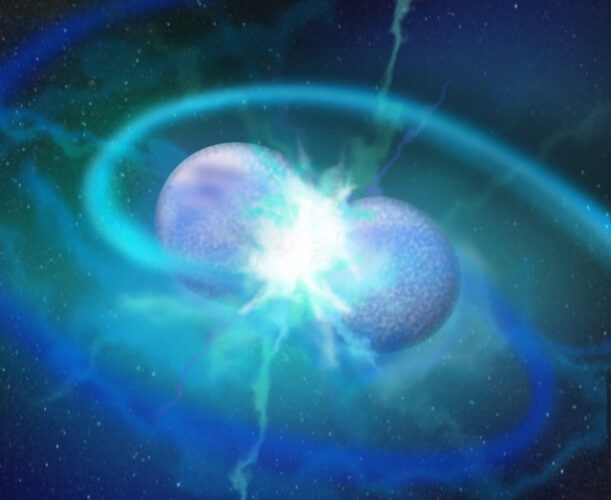
Artist's concept of two white dwarf merging (Image Nicole Reindl (CC BY 4.0))

Two articles published in the journal “Monthly Notices of the Royal Astronomical Society: Letters” report different aspects of a study on two anomalous stars, as they’re two subdwarfs that have carbon and oxygen on the surface instead of hydrogen and helium. A team led by Professor Klaus Werner of the German University of Tübingen discovered the two stars, cataloged as PG 1654+322 and PG 1528+025 as part of a research aimed at better understanding the final stages of stellar evolution. A team led by Dr. Miller Bertolam of the Institute of Astrophysics of La Plata, Argentina, offered a possible explanation for the two anomalous stars by explaining in one of two articles that they could have formed as a result of mergers between two white dwarfs.