The Progress MS-19 cargo spacecraft blasting off atop a Soyuz-2.1a rocket (Image courtesy Roscosmos)

A few hours ago, the Progress MS-19 spacecraft blasted off atop a Soyuz-2.1a rocket from the Baikonur Cosmodrome in Kazakhstan. After about nine minutes it successfully separated from the rocket’s last stage and was placed on its route. The cargo spacecraft began its resupply mission to the International Space Station also called Progress 80 or 80P. In this mission, the route used is the one that requires about two days.

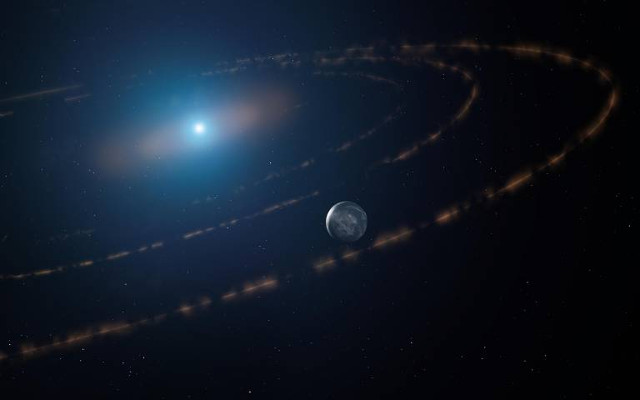
Artist's concept of WD1054-226's system (Image courtesy Mark A. Garlick / markgarlick.com)

An article published in the journal “Monthly Notice of the Royal Astronomical Society” reports the observation of debris orbiting the white dwarf cataloged as WD1054-226 in a formation that suggests a gravitational bond such as the one which can be generated by a planet. A team of researchers used the ULTRACAM camera mounted on ESO’s NTT telescope at La Silla Observatory in Chile to examine objects that regularly pass in front of those star remnants. Data obtained from NASA’s TESS space telescope helped identify what appears to be a disk of debris that hasn’t dispersed, perhaps thanks to a planet acting as a sort of shepherd that keeps them bound. The planet would be in ​​that system’s habitable area, a special case since it has a white dwarf at its center.

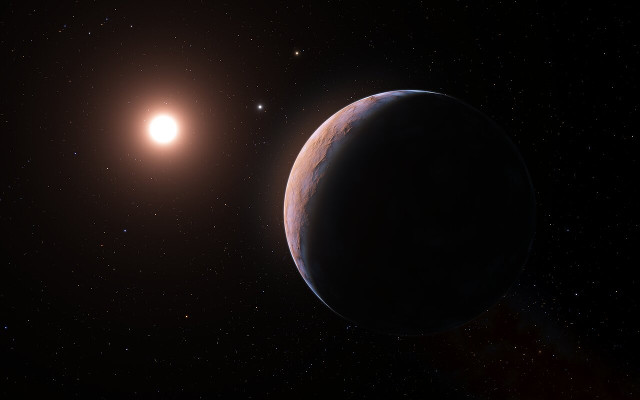
Artist’s impression of Proxima d and Proxima Centauri (Image ESO/L. Calçada)

An article published in the journal “Astronomy & Astrophysics” reports the discovery of another rocky planet in the Proxima Centauri system. A team of researchers led by João Faria of the Instituto de Astrofísica e Ciências do Espaço, Portugal, used detections conducted with the ESPRESSO spectrograph mounted on ESO’s VLT in Chile to find the traces of the planet that was cataloged as Proxima d. This is the exoplanet with the smallest mass identified with the radial velocity method since the estimated minimum mass is about a quarter of the Earth’s, twice Mars’s. Its distance from Proxima Centauri is around 4 million kilometers, so it’s more similar to Venus or Mercury.

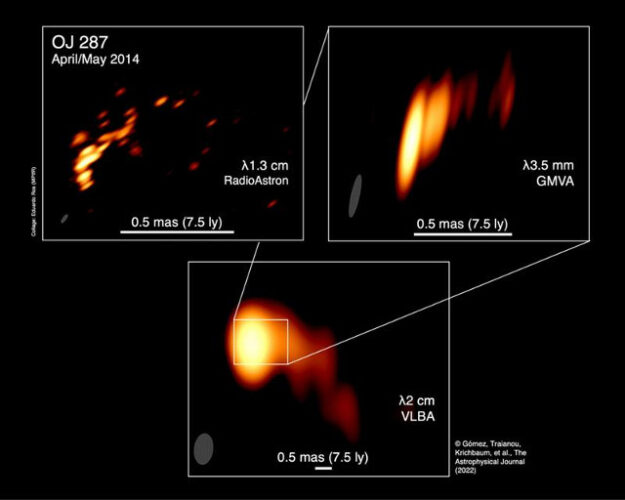
The blazar OJ 287 observed at different wavelengths by RadioAstron, GMVA, and VLBA

An article published in “The Astronomical Journal” reports observations of the blazar OJ 287 conducted by combining different radio telescopes in various areas of the world and the RadioAstron antenna in space. A team of researchers obtained in this way the highest resolution images obtained so far of OJ 287. They confirm the presence of two supermassive black holes powering the active galactic nucleus, one of the reasons why this blazar has been the focus of many scientists’ interest for a long time.

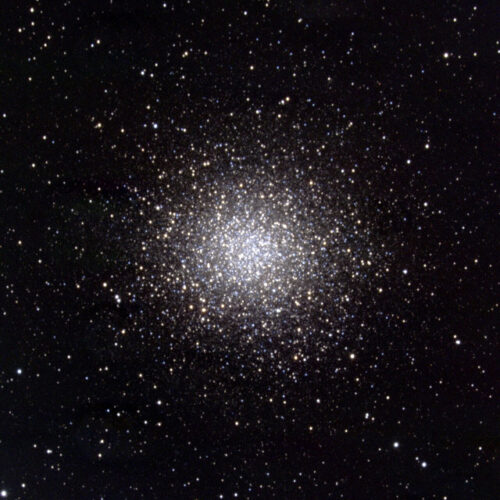
The globular cluster M14 (Image NOIRLab/NSF/AURA)

An article published in “The Astrophysical Journal” reports the results of observations of the globular cluster M14. A team of astronomers led by Francesca D’Antona of the Italian National Institute of Astrophysics, Rome, used the Hubble Space Telescope to study M14, discovering that over a third of the stars in M14 contains an amount of helium never observed outside globular clusters, as it has peaks higher than 30% of their mass. According to the researchers, the most likely explanation is that these are second-generation stars that swallowed the helium ejected by first-generation stars during their agony.