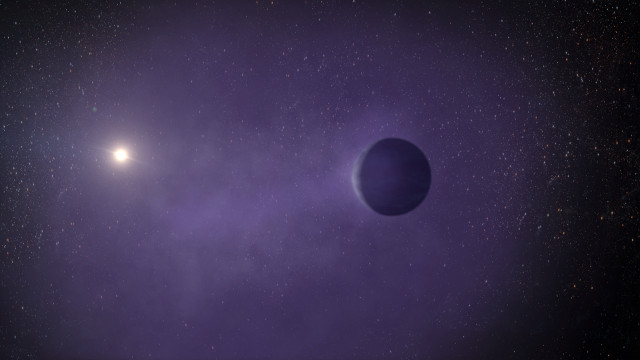
Artist's concept of the exoplanet TOI 560.01 with its star (Image Adam Makarenko (Keck Observatory))

Two articles published in “The Astronomical Journal” report studies on as many exoplanets of the mini-Neptune type that are losing their atmosphere. Two teams led by Michael Zhang with other members in common used the Hubble Space Telescope to study the exoplanet HD 63433c and the Keck Observatory in Hawaii to study the exoplanet TOI 560.01, also known as HD 73583b. In both cases, the XMM-Newton space telescope was used to study the high-energy emissions from their stars and from the outflow of gas from their atmospheres. Observations of gas leaking into space is a confirmation of the theory that mini-Neptunes can transform into super-Earths at the end of that loss.

A map of the of the cosmic microwave background radiation with the apparent anisotropies

An article published in “The Astrophysical Journal Letters” offers a solution to two of the major problems currently existing in the field of cosmology. Prabhakar Tiwari, Rahul Kothari, and Pankaj Jain propose the so-called superhorizon modes: modes in the sense of cosmic components and superhorizon as beyond the observable universe. The researchers believe that they can explain why the universe appears to us not entirely homogeneous and the so-called tension resulting from too different values ​​of the expansion universe expansion velocity resulting from different methods of calculating them.

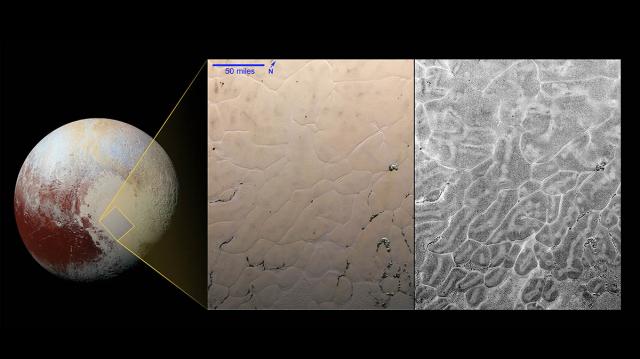
Pluto and Sputnik Planitia

An article published in the “Journal of Geophysical Research: Planets” reports a study that once again addresses the question of the possibility that the dwarf planet Pluto has or at least had in the past an underground ocean. P. J. McGovern, O. L. White, and P. M. Schenk used data collected by NASA’s New Horizons space probe to analyze in particular the geological features of Sputnik Planitia, a vast basin that makes up the western part of Pluto’s heart-shaped region. The results are important to assess for example the thickness of its lithosphere and how this dwarf planet was formed.

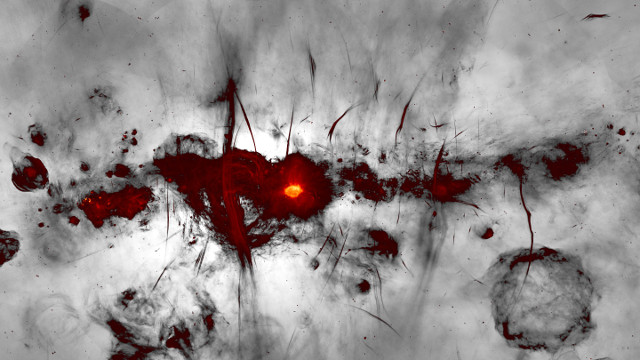
The Milky Way center as seen by MeerKAT

Two articles accepted for publication, one in “The Astrophysical Journal” and one in “The Astrophysical Journal Letters”, report different aspects of a study on the Milky Way’s center. A team of researchers used the MeerKAT radio telescope to examine the galactic center with a clarity and depth never obtained before. This made it possible to obtain new information on radio bubbles, supernova remnants, star nurseries, the region around the supermassive black hole at the center of the Milky Way, and many radio filaments.

Perspective view of Jovis Tholus

An image captured by ESA’s Mars Express space probe’s High Resolution Stereo Camera (HSRC) shows the Jovis Tholus shield volcano on Mars and the surrounding area with its geological features. The Tharsis region where Jovis Tholus is located includes some large volcanoes, first of all, Olympus Mons, the largest volcano in the solar system. Jovis Tholus’s interconnected calderas indicate a long period of volcanic activity and the more recent ones, each of which has a slightly lower floor, end up meeting even more recent lava flows. At 1,500 meters high and 58 kilometers in diameter, Jovis Tholus is much smaller than Olympus Mons yet provides a lot of information about the geology of the Tharsis region and its volcanic activity.