Hot spots on Jupiter

New discoveries on the planet Jupiter made thanks to the work of NASA’s Juno space probe were presented at the American Geophysical Union’s fall conference, which was virtual this year. In particular, new information was collected regarding the so-called hot spots, areas of the Jovian atmosphere that are denser and warmer than expected. Juno made it possible to obtain data that suggests that they’re larger and deeper than previously thought. Another news on Jupiter is that the new cyclone discovered last year at the planet’s south pole has dissolved.

The eROSITA bubbles

An article published in the journal “Nature” reports the discovery of a gigantic structure formed by hot gas with a shape similar to that of an hourglass with lobes that extend from the center of the Milky Way. A team of researchers used observations conducted with eROSITA, one of the instruments of the Spektr-RG space telescope, which identified this structure at X-rays that is very similar to the so-called Fermi bubbles.

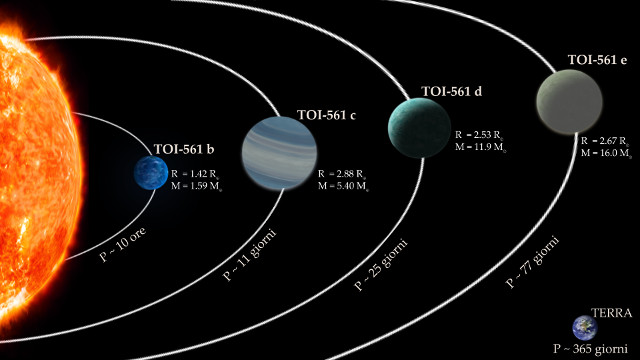
The TOI-561 system

An article published in the journal “Monthly Notices of the Royal Astronomical Society” reports a study on the planetary system of the star TOI-561, which includes a super-Earth and three mini-Neptune. A team of researchers used data from NASA’s TESS space telescope and follow-up research with the HARPS-N spectrograph mounted on the Galileo National Telescope (TNG) on the Canary Island of La Palma to distinguish the traces of the planets and to measure some of their characteristics.

Starship SN8 blasting off (Image courtesy SpaceX)

It was afternoon in the USA when SpaceX conducted the first flight test of a prototype of Starship, the one identified as SN8, in Boca Chica, Texas. Equipped with 3 Raptor engines, SN8 flew regularly up to an altitude of approximately 12.5 kilometers, then attempted a controlled landing at the end of a series of maneuvers. During the ascent it remained in a vertical position while during the descent it carried out various maneuvers that brought it to a horizontal position almost to the ground, where it turned over. However, after 6 minutes and 42 seconds of flight, SN8 landed too fast and was consequently destroyed. Despite the ending, the test was in many ways really positive.