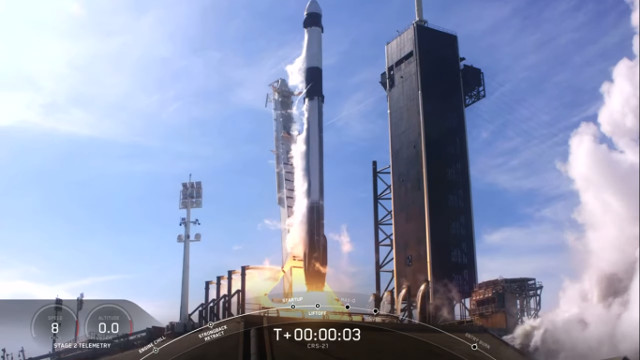
SpaceX's Dragon 2 spacecraft blasting off atop a Falcon 9 rocket (Image courtesy SpaceX)

A little while ago the SpaceX Dragon 2 spacecraft blasted off atop a Falcon 9 rocket from Cape Canaveral in its CRS-21 (Cargo Resupply Service 21) mission, also referred to as SPX-21. After just over eleven minutes it separated successfully from the rocket’s last stage and went en route. This is the 21st mission for the Dragon spacecraft to resupply the International Space Station with various cargoes and then return to Earth, again with various cargoes. It’s the first mission for this Dragon version.

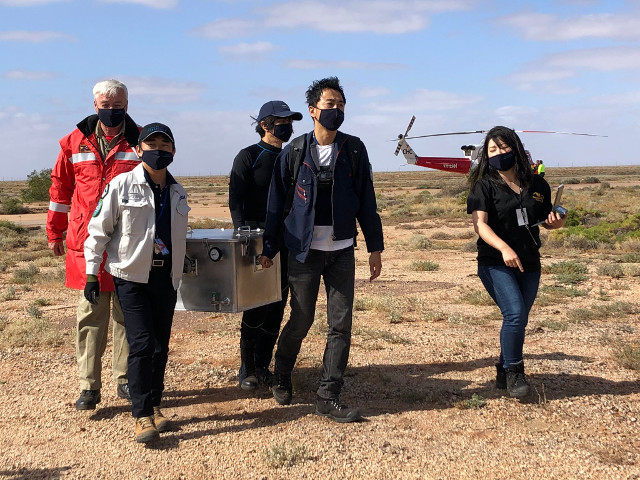
The samples from asteroid Ryugu after getting recovered (Photo courtesy JAXA. All rights reserved)

Yesterday, the Japanese space probe Hayabusa 2 released the capsule containing the samples taken from asteroid Ryugu to Earth. The capsule landed in Australia’s Woomera region. A few hours later, the space agency JAXA crew confirmed that they recovered the capsule and started preparations for its transport to the laboratory in Japan where it will be opened to start examining its contents.

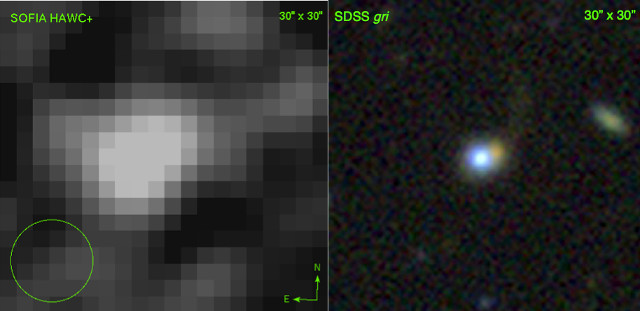
Views of galaxy CQ 4479

An article published in “The Astrophysical Journal” reports a study on the galaxy CQ 4479, where a quasar was observed, an active galactic nucleus with a supermassive black hole that is devouring large amounts of matter, and at the same time an intense star formation. A team of researchers used the SOFIA flying telescope to observe CQ 4479, and found this situation called a cold quasar because the active galactic nucleus is very hot but the galaxy also contains cold gas that gives birth to new stars. This is a rare case that could show an astronomically short period in the evolution of a galaxy before the quasar starts inhibiting star formation.

The Moon's surface seen by the Chang'e-5's lander, including its shadow (Photo courtesy China National Space Administration/CLEP)

It was night in China when the lander and ascent vehicle of the Chinese Chang’e-5 mission successfully completed their Moon landing maneuvers. The various modules that make up Chang’e-5 were launched when it was November 24 in China and reached the Moon’s orbit in recent days. At that point, a series of maneuvers begun to make its orbit circular, the modules that were scheduled to land separated, and everything went well. Very soon, the lander was scheduled to begin its excavation work to collect soil and subsoil samples that will be sent into orbit to be returned to Earth around mid-December.

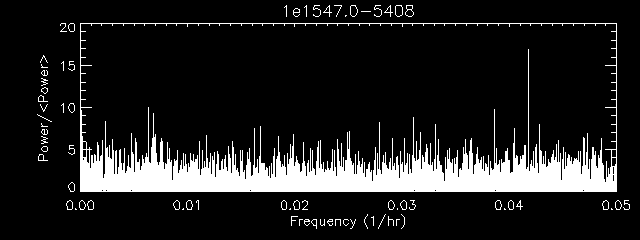
Emissions from 1e1547.0-5408

An article accepted for publication in “The Astrophysical Journal” reports a new analysis of observations conducted in 2009 of the magnetar cataloged as 1E1547.0-5408. A team of researchers led by GianLuca Israel of the Italian National Institute of Astrophysics in Rome used data collected by the Parkes radio telescope and NASA’s Chandra and ESA’s XMM-Newton X-ray space observatories to search for emissions from 1E1547.0-5408. The result was the discovery of strong close emissions of X-rays and radio waves that confirm a link between magnetars and fast radio bursts, the focus of recent research.