Some of the galaxies observed in the GAMA project

An article published in the journal “Monthly Notices of the Royal Astronomical Society” proposes a new way of studying star formation in galaxies. A team of researchers led by Sabine Bellstedt of the International Center for Radio Astronomy Research (ICRAR) developed a technique to analyze the metallicity, which is the abundance of elements heavier than helium, of galaxies. Those elements are produced by stars so their amount increases over time and the more massive ones produce more as well as emit more light. By combining the analysis of metallicity with that of the brightness of galaxies it offers information on the masses of stars. The resulting model offers information on the history of star formation, and the application to a sample of 7,000 galaxies indicates that most stars formed in the first 4 billion years of the universe’s life.

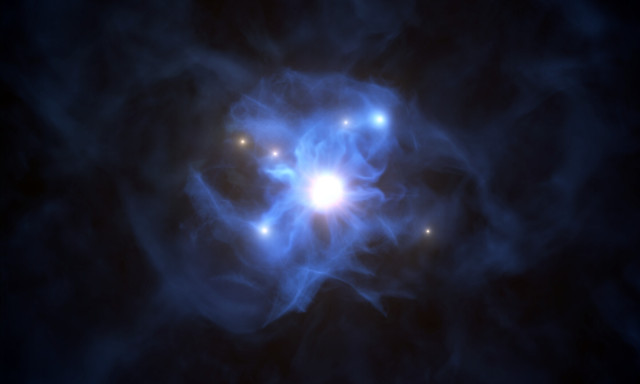
Artist's concept of a supermassive black hole surrounded by galaxies within a cosmic web (Image ESO/L. Calçada)

An article published in the journal “Astronomy & Astrophysics Letters” reports a study on a group of six galaxies surrounding a supermassive black hole which date back to an early epoch when the universe was less than a billion years old. A team of researchers led by Marco Mignoli of the Italian National Institute of Astrophysics (INAF), Bologna, used ESO’s Very Large Telescope (VLT) and the Large Binocular Telescope (LBT) to observe that structure which turned out to be complex as it includes filaments of matter that extend for a distance over 300 times the size of the Milky Way. The gas that concentrates in that structure forms what have been likened to the threads of a spider’s web, and that gas could be responsible for the development of a supermassive black hole in such a remote time.

The Cygnus Kalpana Chawla starts its NG-14 mission blasting off atop an Antares rocket (Photo Wallops/Patrick Black)

A few hours ago Northrop Grumman’s Cygnus spacecraft blasted off atop an Antares rocket from the Mid-Atlantic Regional Spaceport (MARS), part of NASA’s Wallops Flight Facility (WFF) on Wallops Island. After about nine minutes it successfully separated from the rocket’s last stage went en route to its destination. This is its 14th official mission, called NG-14 or CRS NG-14, to transport supplies to the International Space Station for NASA.

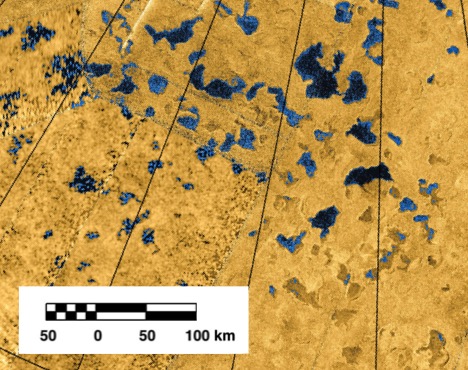
Titan's Lakes

An article published in the journal “The American Astronomical Society” reports a study on the hydrocarbon lakes existing on Titan, the great moon of Saturn, showing its similarities with the Earth’s lakes. A team of researchers led by Jordan Steckloff analyzed data collected by the Cassini space probe and discovered that the lakes of Titan composed of methane, ethane, and nitrogen form layers similar to the ones on Earth. The stratification mechanisms are different because on Earth layers are the consequence of temperature while on Titan they exist because of the particular chemical interactions between the surface liquids and the atmosphere.