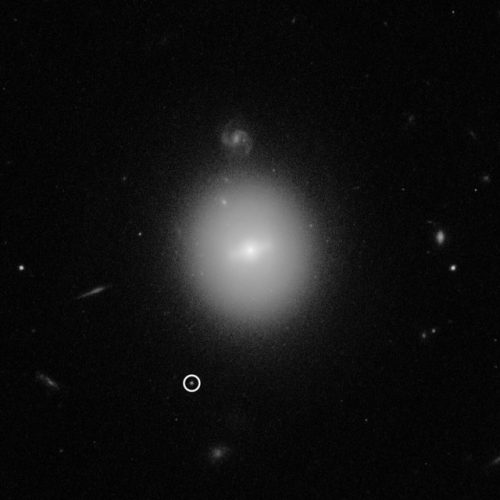
3XMM J215022.4-055108 in the circle (Image NASA, ESA, and D. Lin (University of New Hampshire))

An article published in “The Astrophysical Journal Letters” reports the discovery of the best evidence so far of the existence of intermediate-mass black holes. A team of researchers led by Dacheng Lin of the University of New Hampshire used the Hubble Space Telescope for a follow-up study based on X-ray data collected by other space telescopes that observed the source cataloged as 3XMM J215022.4-055108. The result is that this source is located in a dense star cluster on the periphery of another galaxy and the characteristics indicate that it’s an intermediate-mass black hole with a mass over 50,000 times the Sun’s.

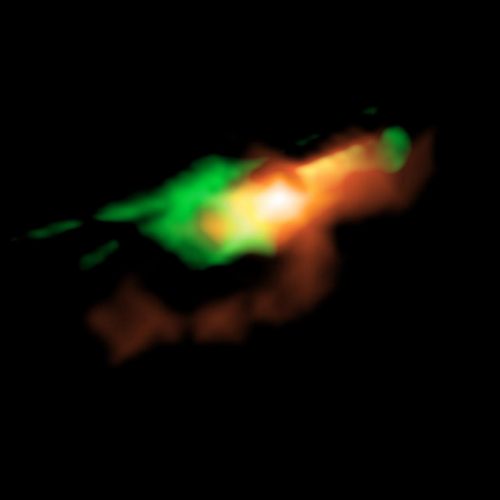
The quasar MG J0414+0534

An article published in “The Astrophysical Journal Letters” reports the observation of jets of energetic particles coming from a supermassive black hole interacting with clouds of gas around them in the quasar MG J0414+0534, about 11 billion light years away. A team of researchers used the ALMA radio telescope to observe that quasar, but its details were detected thanks to a gravitational lensing effect generated by a galaxy between the quasar and the Earth. The interaction between jets and clouds suggests that the quasar’s radio activity is at an early stage and therefore useful to better understand the early stages of evolution of the galaxies that host a quasar in the early universe.

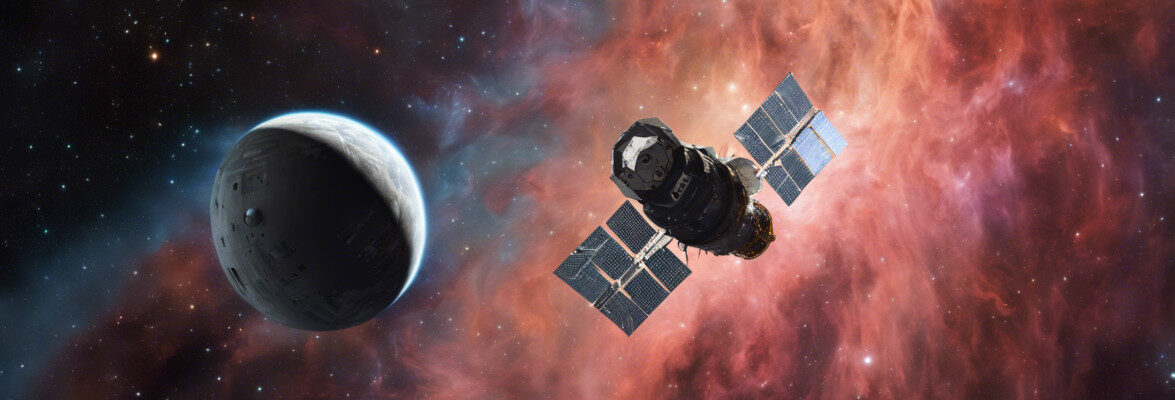
Artist's concept of the Dragon XL cargo spacecraft after separating from the Falcon Heavy rocket's second stage (Image courtesy SpaceX)

NASA has announced that it has selected SpaceX as the first supplier in the Gateway Logistics Services contract to transport cargo, experiments and other supplies to the Lunar Gateway, part of the Artemis program that aims to bring astronauts back to the Moon. At least two missions will be carried out with the Dragon XL cargo spacecraft, a new variant of the Dragon 2 cargo optimized to carry over 5 metric tons of cargo to the Moon’s orbit. The timeline for these missions isn’t clear due to the NASA’s changes of plans, as recently the agency decided to skip the use of the Lunar Gateway for the mission that’s supposed to take place by 2024 and use it in the following years.

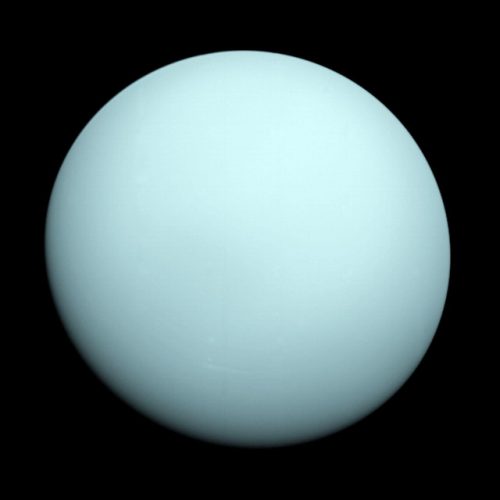
Uranus seen by Voyager 2 (Image NASA/JPL-Caltech)

An article published in the journal “Geophysical Research Letters” reports the discovery of a plasmoid, a structure composed of plasma formed mainly of hydrogen in the midst of magnetic fields, in the magnetotail – the magnetosphere’s tail – of the planet Uranus that was moving away from it. The plasmoid’s formation isn’t a new event because Gina DiBraccio and Daniel J. Gershman of NASA’s Goddard Space Flight Center examined the observations made by the Voyager 2 space probe during the its Uranus flyby on January 24, 1986. It’s the first plasmoid discovered in the Uranus’ atmosphere and could be a crucial mechanism for its loss of atmosphere.

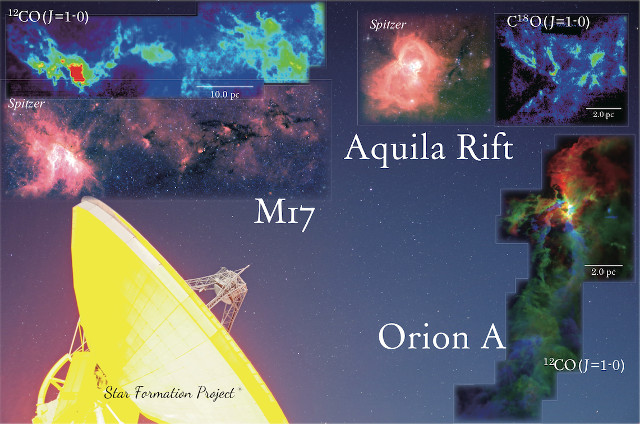
Star Formation Project montage

An article published in the journal “Publications of the Astronomical Society of Japan” reports the mapping of three interstellar clouds: Orion A, Aquila Rift, and M17. A team of researchers led by Professor Fumitaka Nakamura of the National Astronomical Observatory of Japan (NAOJ) used the Nobeyama radio telescope and for Orion A also data from the CARMA radio telescope array archive to achieve this result. This is an investigation not surprisingly called the Star Formation Project because the three interestellar clouds studied are nurseries for new stars.