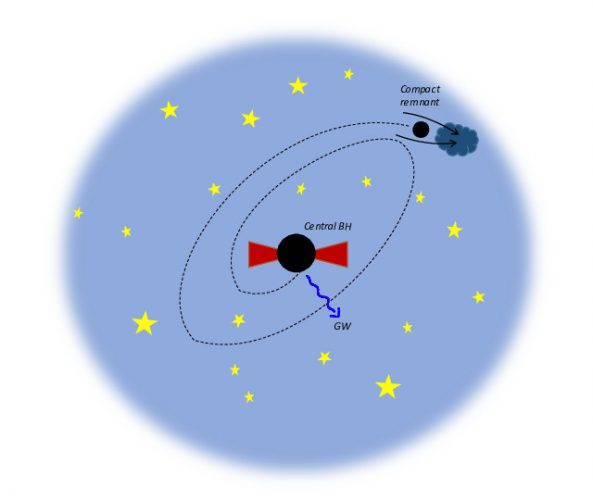
Illustration of the quick growth mechanism for supermassive black holes

An article published in “The Astrophysical Journal” reports a study on a possible quick growth mechanism of supermassive black holes that could explain their presence when the universe was very young. Ph.D. student at SISSA (International School of Advanced Studies) Lumen Boco and his supervisor Andrea Lapi created a new model based on a process already considered important called dynamical friction in the gaseous medium applying it to multiple mergers.

Two examples of aligned and misaligned protoplanetary disks around binary stars

An article published in “The Astrophysical Journal” reports a study on the orbits of protoplanetary disks in binary systems, where different geometries were found. A team of astronomers led by Ian Czekala of the University of California at Berkeley used the ALMA radio telescope to study star systems in formation around two stars, which in jargon are called circumbinary disks. The conclusion is that the disks that orbit the more compact binary systems share almost the same plane while the disks that orbit the wider binary systems have significantly tilted orbital planes.

Illustration of photon subrings around a black hole

An article published in the journal “Science Advances” reports a study on the possibility of obtaining sharp images of the subrings that form the photon ring around a black hole. A team of researchers led by Michael Johnson of of the Center for Astrophysics – Harvard and Smithsonian (CfA) worked on the feat announced almost a year ago with the publication of the photo of the area around the supermassive black hole at the center of the galaxy M87. The researchers think that adding a space telescope to the ones used by the Event Horizon Telescope (EHT) collaboration would allow to obtain the sharpness needed to distinguish one of the subrings, whose characteristics would allow to obtain more precise measurements of the mass of the black hole and more.

Eros Vanzella indicates the Lyman-Alpha emission region measured with the MUSE instrument (Photo courtesy Eros Vanzella / INAF. All rights reserved)

An article published in the journal “Monthly Notices of the Royal Astronomical Society” reports the discovery of primordial stars that could belong to the so-called Population III, the first generation of stars in the universe. A team of astrophysicists led by Eros Vanzella and Massimo Meneghetti of the Italian National Institute of Astrophysics, Bologna, used data collected with the MUSE instrument mounted on ESO’s VLT and a powerful gravitational lens generated by the galaxy cluster MACS J0416.1-2403, or simply MACS J0416, to obtain magnified images of stars that seem free of metals and composed only of hydrogen, helium and traces of lithium.

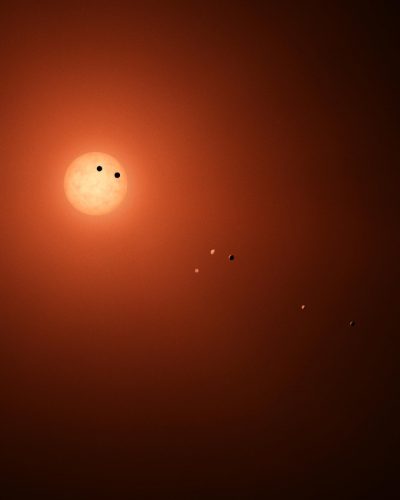
Artist's concept of TRAPPIST-1 and its planets (Image NASA/JPL-Caltech)

An article published in “The Astrophysical Journal” reports a study on the X-ray and ultraviolet (XUV) luminosity of TRAPPIST-1, the ultra-cool dwarf star that became famous after the confirmation that it has a system of 7 rocky planets. A team of researchers used a Markov Chain Monte Carlo method to calculate the radiation received over time by those planets concluding that the star had high levels of X-ray and ultraviolet emissions for several billion years causing its planets significant atmospheric erosion and loss of volatile compounds. The researchers also showed that the free / open source approxposterior software can replicate their analysis much faster than emcee, a software used for that type of calculation. This will help to study other red dwarfs to evaluate the habitability of the planets that are increasingly found orbiting red dwarfs.