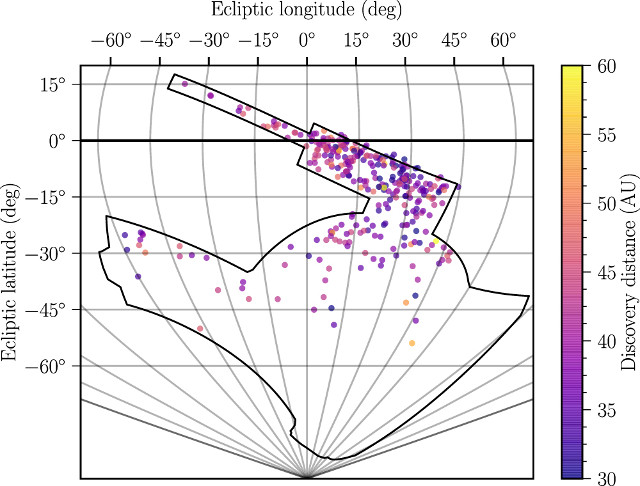
Position and distance diagram of the trans-neptunian objects detected

An article published in “The Astrophysical Journal” presents a catalog of 316 trans-neptunian objects detected by the Dark Energy Survey (DES) during the first four years of operations. A team led by Pedro Bernardinelli analyzed the data collected with a patient work to eliminate the fixed objects and then focused on the transient ones until they obtained the identification of 245 objects already known and 139 that were hitherto unknown. They’re at distances between 30 and more than 90 times the Earth’s from the Sun. Their detection will help to understand their origin and in general the Kuiper belt, where someone thinks that there may be another planet.

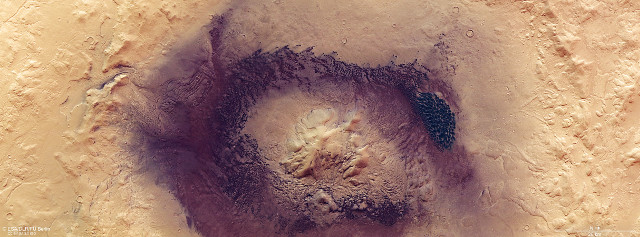
Moreux Crater on Mars

ESA has released new photos of Moreux Crater on the planet Mars taken by the Mars Express space probe’s High Resolution Stereo Camera (HRSC). It’s an impact crater, but shows characteristics that are out of normal, considered the result of erosion caused by glacial processes. Glaciations probably occurred in different periods since the geological traces present in the area suggest that they occurred even in the last millions of years. Another reason for interest in this crater is the presence of dunes inside it, which provide information on the winds blowing in the area.

Artist's concept of iron rain on the exoplanet WASP-76b (Image ESO/M. Kornmesser)

An article published in the journal “Nature” reports a study on the conditions existing on the exoplanet WASP-76b, an ultra-hot Jupiter where on the side illuminated by its star it’s so hot that metals vaporize and then condense on the dark side, where it rains iron. A team of researchers led by David Ehrenreich of the University of Geneva, Switzerland, used the ESPRESSO instrument mounted on the VLT in Chile to study the processes underway in the atmosphere of WASP-76b with the winds that carry the iron vapor across this gas giant.

Thiophene structure

An article published in the journal “Astrobiology” reports a study on the possible origin of organic compounds known as thiophenes discovered on Mars by NASA’s Mars Rover Curiosity. Jacob Heinz of the Technische Universität in Berlin and Dirk Schulze-Makuch of Washington State University described some possible processes leading to the formation of thiophenes. These possible processes can be non-biological or biological, and the problem is to find evidence that points to one of them. Thiophenes also exist on Earth and there’s a tendency to think that they’re formed as a result of biological processes, but on Mars this would mean that life forms exist.