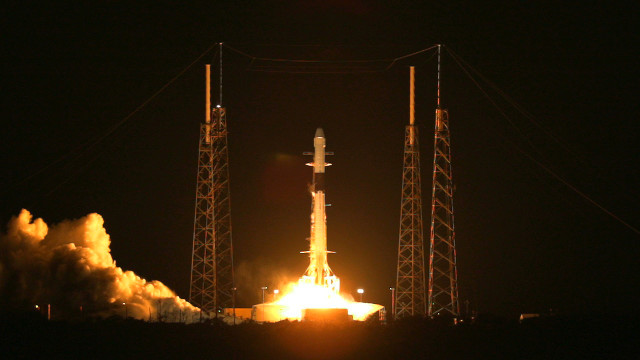
The Dragon cargo spacecraft blasting off for its CRS-20 mission atop a Falcon 9 rocket (Photo NASA)

A few hours ago the SpaceX Dragon spacecraft blasted off atop a Falcon 9 rocket from Cape Canaveral in its CRS-20 (Cargo Resupply Service 20) mission, also referred to as SPX-20. After just over ten minutes it separated successfully from the rocket’s last stage and went en route. This is the 20th mission for the Dragon spacecraft to resupply the International Space Station with various cargoes and then return to Earth, again with various cargoes. It’s the last mission for this Dragon version, which will be replaced by Dragon 2 from the next mission.

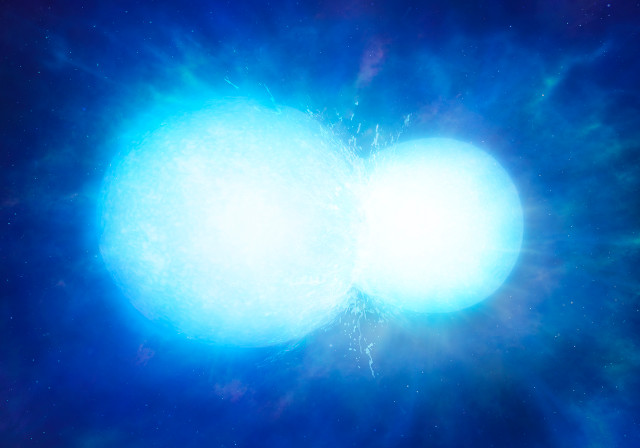
Artist's concept of colliding white dwarfs (Image courtesy University of Warwick/Mark Garlick)

An article published in the journal “Nature Astronomy” reports a study on a white dwarf out of the ordinary cataloged as WD J055134.612+413531.09, or simply WD J0551+4135. A team of astronomers coordinated by the British University of Warwick examined this white dwarf’s characteristics using data collected by ESA’s Gaia space probe and the William Herschel Telescope concluding that its atmosphere’s particular chemical composition indicates that it’s the result the merger of two medium-mass white dwarfs. WD J0551+4135 has a mass slightly higher than that of the Sun, remarkable for that type of object to the point that it was called an ultra-massive white dwarf. If it had a slightly larger mass it would probably have exploded in a supernova following the merger.

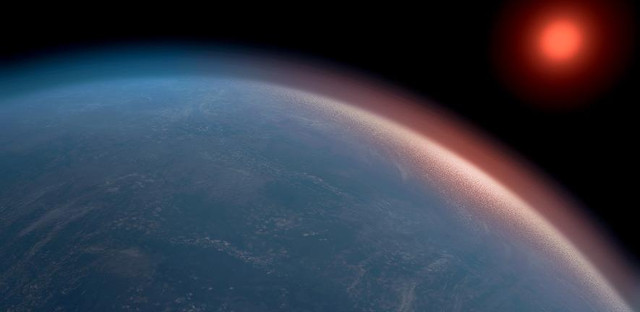
Artist's impression of K2-18b (Image courtesy Amanda Smith)

An article published in “The Astrophysical Journal Letters” reports a study on the potential habitability conditions of the exoplanet K2-18b. A team from the British University of Cambridge led by Nikku Madhusudhan conducted a series of simulations based on the possible values of mass, size, and atmosphere data value available on it to create various models compatible with the observations. According to the conclusions, under certain conditions there may be liquid water on its surface.

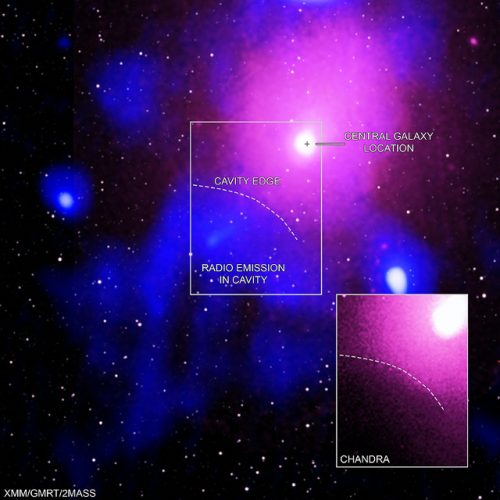
The outburst region in the Ophiuchus supercluster

An article published in “The Astrophysical Journal” reports the observation of what was called the largest explosion discovered in the universe after the Big Bang and caused by the supermassive black hole in the galaxy at the center of the Ophiuchus supercluster. A team of astronomers led by Simona Giacintucci of the Naval Research Laboratory combined X-ray observations with ESA’s XMM-Newton and NASA’s Chandra space telescopes with those at radio frequencies conducted with Murchison Widefield Array (MWA) and Giant Metrewave Radio Telescope (GMRT) radio telescopes to map the cavity generated by that cataclysmic event, about 15 times the Milky Way’s size.

The Sombrero Galaxy

An article published in “The Astrophysical Journal” reports a study on the Sombrero Galaxy and in particular on its halo. A team of researchers used the Hubble space telescope, finding a surprising abundance of stars rich in heavy elements, and computer simulations to try to understand the origin of this galaxy difficult to catalog because it’s a hybrid between the elliptical and the spiral shapes. The conclusion is that its growth occurred from the merging of two or perhaps even more massive galaxies in a chaotic process.