Interstellar comet 2I/Borisov seen from the Keck Observatory

A new photo of interstellar comet 2I/Borisov taken using a spectrometer at the Keck Observatory in Hawaii is now the best obtained so far and can offer new information on this object that is going through the solar system. Astronomers Pieter van Dokkum, Cheng-Han Hsieh, Shany Danieli and Gregory Laughlin of Yale University captured this image on November 24 and it includes the comet’s tail, shown in its length of nearly 160,000 kilometers in a composition that puts together 2I/Borisov and the Earth.

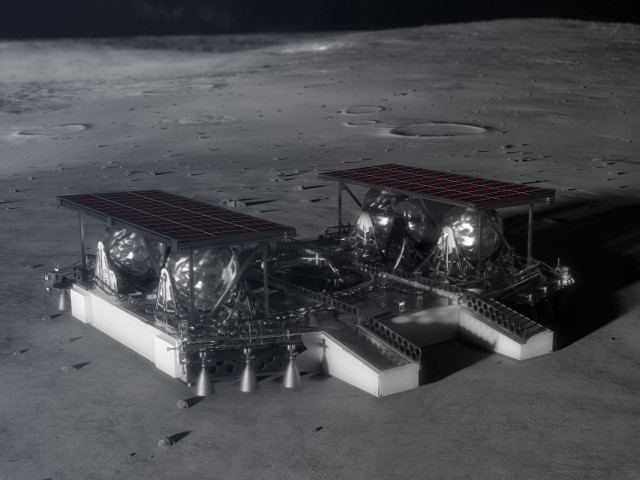
Artist's concept of lander on the Moon's surface (Image NASA)

NASA presented a medium-sized lunar lander concept that could be used during missions in the next few years within the Artemis program. The aim is to bring human beings back to the Moon, but manned missions involve a series of scientific studies with the aim of creating a stable base. Various scientific instruments and rovers will be needed that can make explorations on the lunar surface, payloads that can be brought to the surface by a lander of a type compared to a pallet. A technical publication of the concept offers references for the industries that collaborate with NASA.

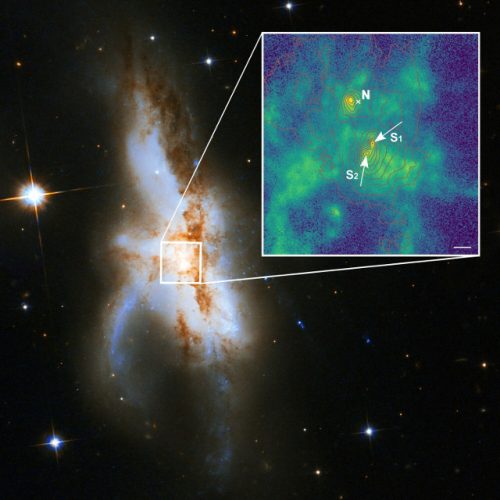
The galaxy NGC 6240 contains three supermassive black holes

An article published in the journal “Astronomy & Astrophysics” reports a study on the galaxy NGC 6240 with evidence that it contains three supermassive black holes. A team of researchers led by Professor Wolfram Kollatschny of the University of Göttingen used the MUSE instrument mounted on ESO’s VLT in Chile together with data from previous studies to obtain the high-precision observations needed to verify that within NGC 6240 there were not two supermassive black holes as it seemed from previous studies but three. This indicates that the current merger is involving three galaxies.

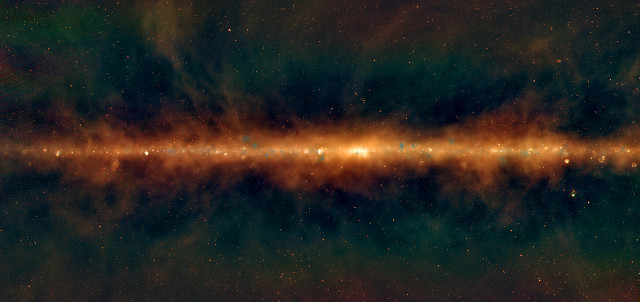
The center of the Milky Way seen in detail by the MWA radio telescope

Three articles published in the journal “Publications of the Astronomical Society of Australia (PASA)” report some results of the GaLactic and Extragalactic All-sky MWA (GLEAM) survey. A team of researchers created some images obtained thanks to the Murchison Widefield Array (MWA) radio telescope showing the center of the Milky Way. Thanks to the low-frequency radio emissions detected, it was possible to generate an image that reproduces both the larger structures and the details. This means that it was possible to obtain an overall image and images of individual objects such as 27 supernova remnants.

The afterglow of GRB 190114C observed by Hubble (Image NASA, ESA, and V. Acciari et al. 2019)

Three articles published in the journal “Nature” report different aspects of the study of a gamma-ray burst cataloged as GRB 190114C which was observed at many frequencies in what’s called multiband observation. Many scientists, particularly the ones from the MAGIC Collaboration, combined observations made using space and ground-based telescopes to study the gamma-ray burst with the greatest energy ever observed. In fact, photons were detected with an energy of the order of the teraelectronvolt, a level theorized for a long time but only now confirmed. A fourth article to be published in the journal “Astronomy and Astrophysics” reports an analysis of the galaxy in which GRB 190114C occurred.