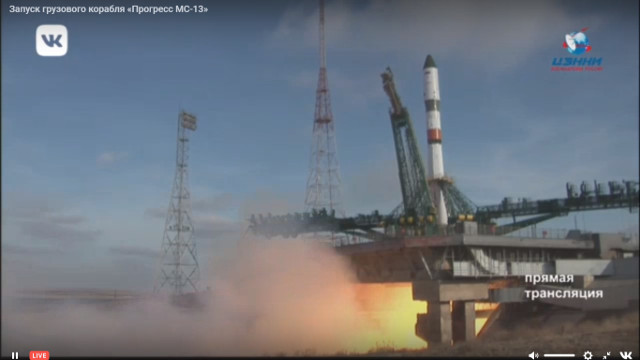
The Progress MS-13 cargo spacecraft blasting off atop a Soyuz-2.1a rocket (Image courtesy Roscosmos)

A little while ago the Progress MS-13 spacecraft blasted off atop a Soyuz-2.1a rocket from the Baikonur Cosmodrome in Kazakhstan. After about nine minutes it successfully separated from the rocket’s last stage and was placed on its route. The cargo spacecraft began its resupply mission to the International Space Station also called Progress 74 or 74P. In this mission, the route used is out of the ordinary since the journey will last about three days.

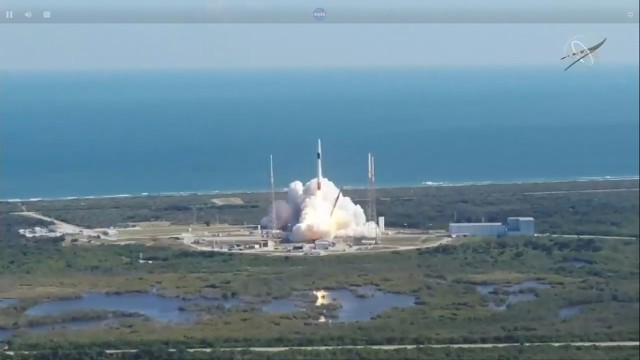
The Dragon cargo spacecraft blasting off atop a Falcon 9 rocket (Image NASA TV)

A little while ago the SpaceX Dragon spacecraft blasted off atop a Falcon 9 rocket from Cape Canaveral in its CRS-19 (Cargo Resupply Service 19) mission, also referred to as SPX-19. After just over ten minutes it separated successfully from the rocket’s last stage and went en route. This is the 19th mission for the Dragon spacecraft to resupply the International Space Station with various cargoes and then return to Earth, again with various cargoes.

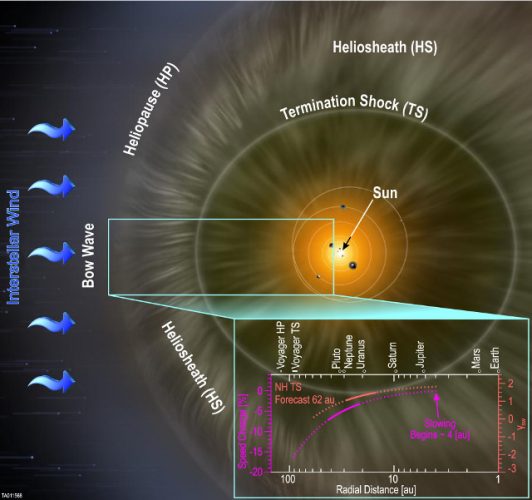
Slowing of the solar wind in the outer solar system

An article published in “The Astrophysical Journal” reports a study on changes in the solar wind in the outer region of the heliosphere, the bubble in which the influence of the Sun is felt. A team of researchers from the Southwest Research Institute led by Dr. Heather Elliott used measurements collected by NASA’s New Horizons space probe’s Solar Wind Around Pluto (SWAP) instrument to compare the speed of the solar wind at distances from the Sun between 1 and 3 times that of the Earth from the Sun and at distances between 21 and 43 times that distance reveals a slowdown between 5% and 7% at distances between 30 and 43 times that of the Earth from the Sun.

Remains of glaciers that sculpted the territory of Deuteronilus Mensae on Mars

ESA has published new images of the region of the planet Mars called Deuteronilus Mensae captured by its Mars Express space probe’s High Resolution Stereo Camera (HRSC) instrument that show a territory sculpted by the movements of glaciers that created formations such as those known as mesas. That’s a particularly interesting region because already in the last decade traces of ice still there were discovered. In the past, there was perhaps a regional ice cap in that area of ​​which Deuteronilus Mensae represents the remains.

The report of Jupiter's Great Red Spot demise might be greatly exaggerated

At the 72nd Annual Meeting of the APS Division of Fluid Dynamics, held in recent days in Seattle, Philip Marcus of the University of California, Berkeley, presented a study on Jupiter’s Great Red Spot. According to recent research, it’s shrinking but according to this new study based on photos and computer simulations that’s actually an impression due to clouds covering a part of it.