Brightest quasar in the early universe discovered

An article published in the journal “Astrophysical Journal Letters” reports the discovery of the brightest quasar in the early universe. A team of researchers used observations of the Hubble Space Telescope and some ground-based telescopes to identify the galaxy cataloged as J043947.08+163415.7 at a distance of about 12.8 billion light years from the Earth. The supermassive black hole at its center is surrounded by a lot of materials that emit the huge amount of light that allows it to be identified even at that enormous distance, but only thanks to a gravitational lensing effect. That activity dates back almost a billion years after the Big Bang.

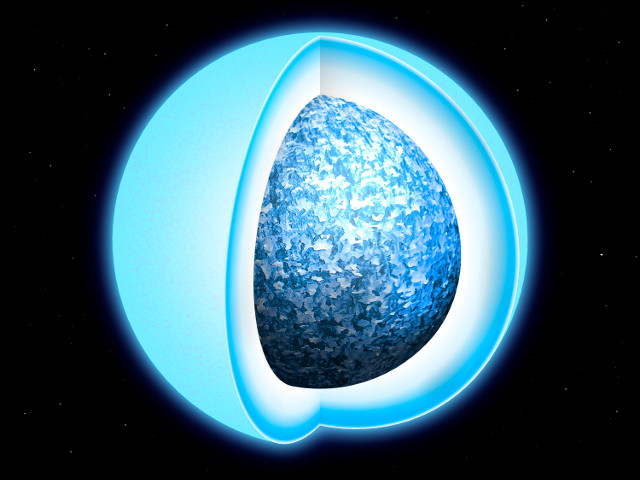
Artist’s impression of crystallisation in white dwarf (Image courtesy University of Warwick/Mark Garlick. All rights reserved)

An article published in “Nature” shows the evidence that in white dwarfs oxygen and carbon slowly crystallize from their cores. A team of researchers used data collected by ESA’s Gaia space probe that include distance, brightness and color of hundreds of thousands of white dwarfs analyzing over 15,000 candidates within 300 light years away from Earth to collect evidence of the crystallization process. This is the first verification of a prediction dating back to the beginning of the 1960s.

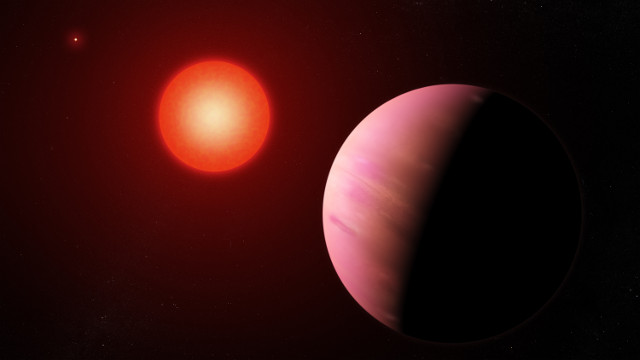
Artist's concept of the exoplanet K2-288Bb with its star and the other red dwarf far away (Image NASA's Goddard Space Flight Center/Francis Reddy)

An article published in the journal “The Astronomical Journal” describes the study of the exoplanet K2-288Bb, discovered among the observations made by NASA’s Kepler space telescope with the help of citizen scientists thanks to the Exoplanet Explorers project. Adina Feinstein, a University of Chicago graduate student and lead author of the paper, presented the results at the 233rd meeting of the American Astronomical Society in Seattle held in Seattle.

A verification of dark matter heating

An article published in the journal “Monthly Notices of the Royal Astronomical Society” reports confirmations to the hypothesis of the effect known as dark matter heating. A team of researchers looked for the effects of the presence of dark matter in dwarf galaxies relatively close to the Milky Way, finding the confirmation that star formation can heat it causing it to move outwards. It’s a new possibility to study dark matter to try to understand its nature.

Ultima Thule offers the first answers but leaves many questions open

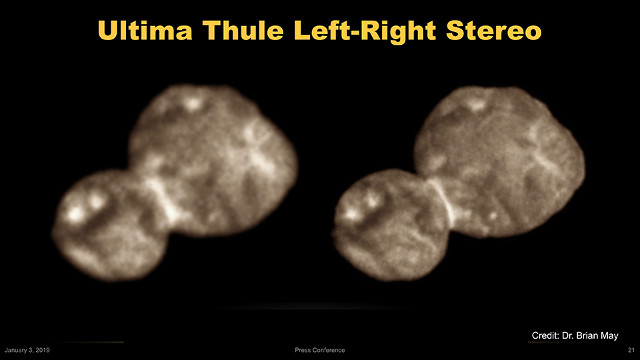
In a press briefing that included a number of scientists working on NASA’s New Horizons mission, the first discoveries on the Kuiper Belt object cataloged as 2014 MU69 and nicknamed Ultima Thule were presented, obtained thanks to data received during the January 1, 2019 flyby. They’re based on information that’s still incomplete, which could be contradicted by high resolution photos and other data but for the moment this object doesn’t appear to have neither moons nor rings, or at least not of relevant sizes, no impact craters were found on its surface nor were traces of atmosphere.